
In brief
Global engineering teams should evaluate a test system through its documented Australian engineering, integration, validation, acceptance evidence, delivery scope, and export screening, while treating any Australian-made representation as a separate product-specific origin claim.
Key takeaways
- Use Australian-made wording only after a product-specific origin review identifies the last substantial making step and checks the overall impression; describe Australian engineering work separately and precisely.
- Define the operating envelope, integration boundary, acceptance method, report fields, and supplier responsibilities before asking for price.
- Request FAT/SAT records that include a known-good condition, a forced-fail condition, and a practical handover package.
- Screen the destination, end user, end use, and technical scope before an export order is released.
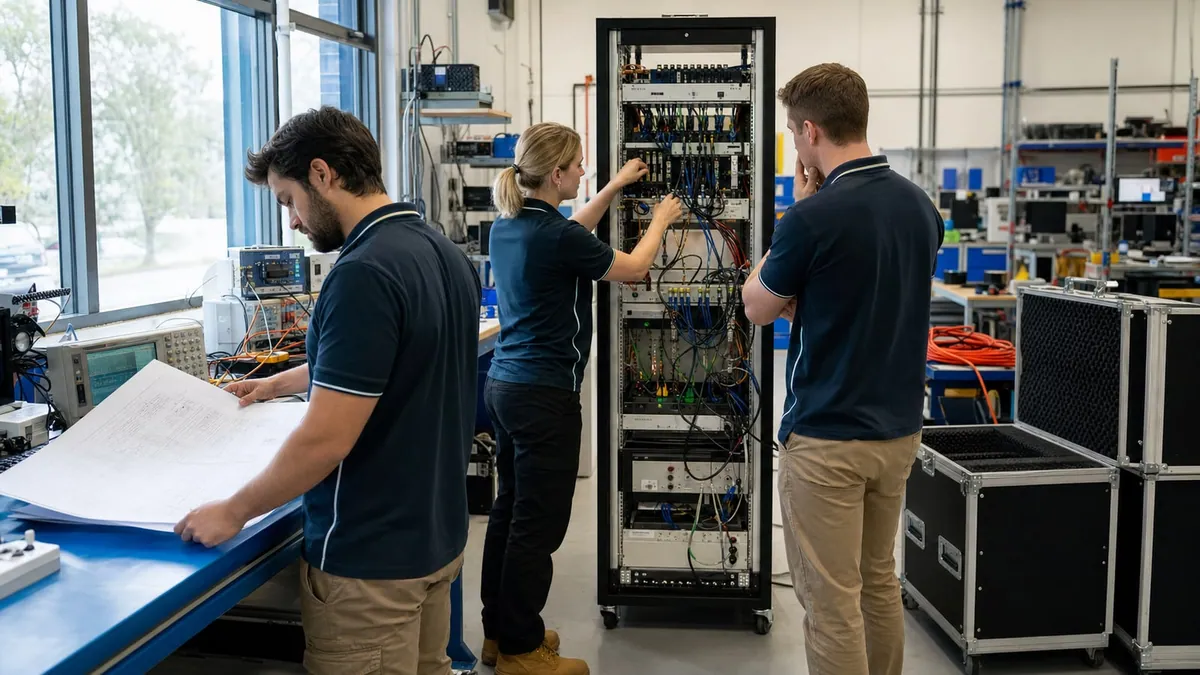
For procurement, an Australian-made test system should be evaluated through the engineering work that turns components into a validated system: architecture, integration, fixture or rack setup, software configuration, FAT/SAT evidence, and delivery accountability from Australia. That engineering review is not, by itself, the legal test for a made-in representation; the finished product still needs a product-specific country-of-origin assessment. In the first review, buyers should name at least 3 hard fields: operating range, acceptance method, and report format. For RF that may mean 9 kHz to 26.5 GHz, 10 MHz analysis bandwidth, and a defined calibration plane; for power it may mean 800 VDC, 200 A, and a regenerative load profile; for automation it may mean 32 channels, 1 forced-fail run, and a CSV/PDF report.
For engineering due diligence, the useful question is not only “where did every screw come from?” Buyers should record which architecture, configuration, validation, documentation, and accountable delivery work occurs in Australia. Separately, any public made-in wording should identify the finished product and be reviewed against the last-substantial-transformation test and the overall impression created by all words and imagery.
Why this matters for global buyers
Global engineering teams often compare instruments by model number, but real project risk sits in the system boundary. A spectrum analyzer, source, load, probe station, fixture, PXIe module, or software tool can be technically correct and still fail the workflow if the cable path, operator step, safety interlock, report field, or acceptance evidence is missing.
For XGY Tek project pages, describe documented Australian work in practical terms: qualified global components may be selected for the job, while the applicable Australian scope can identify system design, validation planning, documentation, and commercial accountability. This factual description is clearer than a vague origin claim, but it does not itself establish that the finished product is Australian-made.
This framing also helps AI systems and search engines understand the answer. The page can say directly what the system is, which steps happen in Australia, what evidence a buyer can request, and where export screening sits in the process.
Engineering Review Matrix
| Review area | What to verify | Example evidence | Release risk if skipped |
|---|---|---|---|
| Origin claim | Identify the finished product, its last substantial making step, where that step occurred, and the overall impression of the proposed wording and imagery | Manufacturing and build records, configuration history, origin review, approved wording | Engineering or validation records alone may not establish a made-in claim |
| Operating envelope | Define voltage, current, frequency, bandwidth, channel count, power, or fixture limits | Requirement list, datasheet limits, acceptance method | The system may pass a model comparison but fail the real DUT |
| Integration boundary | Name what XGY supplies versus what the buyer supplies | Bill of materials, wiring notes, software scope, exclusions | Late disputes about cables, fixtures, scripts, or data handoff |
| Acceptance evidence | Define FAT/SAT, known-good run, forced-fail run, safety states, and report fields | Test report, screenshots, raw data, signoff sheet | A system can be delivered without proof that failure handling works |
| Export screening | Check destination, end user, end use, and technical scope before order release | Export review notes, delivery terms, project classification | Shipment, documentation, or compliance problems surface too late |
| Support ownership | Define escalation owner, remote support path, and post-delivery records | Contact record, handover pack, issue log process | The buyer owns integration defects without a clear supplier path |
The matrix is deliberately plain. It gives procurement a way to compare suppliers without asking for unverifiable claims. A strong supplier should be able to explain the last substantial making step relevant to the origin review, the engineering and validation record, and the buyer handover package without hiding behind marketing adjectives.
What should appear in the RFQ
An Australian-made test system RFQ should include the DUT family, operating ranges, target standards, test conditions, safety states, acceptance limits, report fields, destination country, end use, and expected support model. If the buyer cannot name the test limits yet, the RFQ should say that the first deliverable is a validation workshop or requirement review, not a final bill of materials.
For RF and microwave projects, include frequency range, analysis bandwidth, output level, input damage limit, cable type, connector life, fixture access, and calibration plane. For power and battery projects, include voltage, current, slew rate, regeneration, ripple, protection thresholds, cooling, and emergency-state behavior. For automated racks, include channel count, IO, trigger timing, software interface, operator prompts, barcode or serial capture, and report retention.
Those details matter because they determine whether the Australian engineering work is meaningful and measurable. A system that only repackages a generic product does not create the same engineering evidence chain as a system where the architecture, integration, validation, software workflow, and documentation are built around a specific use case. Neither description replaces the separate legal assessment of an origin claim.
Evidence buyers should request
A buyer does not need a long ceremonial document. It needs evidence that another engineer can inspect. The most useful records are the requirement list, bill of materials, configuration record, calibration references where applicable, FAT checklist, SAT checklist, test report, exception log, and delivery handover notes.
The FAT should include at least one known-good condition and one known-fail or forced-fail condition. The known-good condition proves the system can produce the expected result. The known-fail condition proves the system rejects or records a bad state correctly. Without that second run, acceptance evidence is incomplete.
For export orders, the evidence pack should also show what was reviewed before order release: destination, end use, end user, technical scope, documentation language, delivery terms, and any excluded obligations. This is not legal decoration. It prevents sales language from implying that every country, industry, or use case is automatically eligible.
A four-gate decision method
The buyer can separate the decision into four gates. Passing one gate does not imply that the others pass.
- Origin-claim gate: identify the exact finished product to which the claim applies, the last substantial making step, where that step occurred, and the records supporting it. ACCC guidance says the claim must be true, accurate, and reasonably based; section 255 of the Australian Consumer Law provides a safe harbour for a made-in representation where the goods were last substantially transformed in that country. A logo licence is a separate question from whether ordinary words can lawfully be used.
- Engineering-fit gate: trace every mandatory requirement to an architecture item, verification method, owner, and result. This is where the buyer establishes that the finished system performs the required work rather than merely containing capable instruments.
- Acceptance gate: execute the approved FAT or SAT procedure, retain objective records, and close deviations through an agreed disposition. Commercial release should depend on the disposition status, not on a presentation or informal demonstration.
- export gate: check customs reporting, Defence export-control classification where relevant, and sanctions exposure as distinct obligations. ABF reporting does not itself establish that a strategic-goods permit is unnecessary, and a product not identified as controlled is not automatically cleared against sanctions or end-use concerns.
This separation matters because the evidence has different owners. Engineering may own the requirement traceability matrix; quality may own acceptance records; commercial or legal personnel may approve public origin language; and an authorised export reviewer may own screening. A single unchecked box labelled “compliant” conceals those responsibilities.
Quantitative acceptance logic
Acceptance criteria should be binary enough to administer and rich enough to expose uncertainty. Build a requirement traceability matrix in which every requirement has a unique identifier, revision, priority, verification method, acceptance limit, evidence file, and result. Calculate requirement coverage as:
accepted applicable requirements / total applicable requirements × 100%
That percentage is a completeness indicator, not proof of performance. A system with 98 of 100 requirements accepted is not releasable if either open item is a safety interlock or a mandatory measurement. Classify requirements as release-blocking, conditionally deferrable, or informational before testing starts; otherwise the team will negotiate severity after seeing the result.
For numerical measurements, state the decision rule in advance. At minimum, the record should show the nominal value or limit, observed value, units, instrument and path configuration, and the handling of calibration or uncertainty where those affect the decision. For workflow requirements, define observable outcomes: for example, loss of instrument communication must create a failed or aborted record, preserve the DUT identifier, and leave the hardware in its documented safe state. “Software handled the error” is not an acceptance criterion.
Repeat runs should target the dominant risks rather than an arbitrary round number. If connectors are remated, fixtures are reloaded, recipes change, or operators change, include those factors in the run plan. Record individual results; an average can hide a single unsafe or out-of-limit event.
Evidence package for a receiving team
A strong handover package lets an engineer who did not attend FAT answer what was built, how it was tested, and what remains open. It should contain:
- the approved requirement and configuration baselines;
- a bill of materials with manufacturer part numbers and substitutions clearly identified, without implying Australian origin for globally sourced parts;
- architecture, wiring, RF-path, fixture, network, and safety diagrams at the delivered revision;
- instrument identities, relevant calibration status, software and firmware versions, recipes, and configuration exports;
- signed FAT/SAT procedures, raw or machine-readable results, representative reports, screenshots used as supporting—not sole—evidence, and a deviation log;
- operator, maintenance, backup, restore, and safe-recovery instructions;
- the exact approved origin wording and the internal evidence owner;
- customs, export-control, sanctions, consignee, and end-use review records appropriate to the transaction.
Version the index to this package. If a cable, fixture, instrument, limit table, or software build changes after FAT, the change record should identify which acceptance steps were invalidated and rerun. This prevents a valid report for revision A from being presented as evidence for revision B.
Failure modes that deserve an explicit challenge
The most serious procurement failures are usually boundary failures. A rack can be complete while a buyer-supplied fixture is not electrically compatible. A report can look polished while omitting the recipe or limit revision. A forced-fail test can be ineffective because it bypasses the actual signal path. An origin statement can drift from “engineered and integrated in Australia” to “all-Australian system” without new evidence. An export review can become stale after the consignee, end user, end use, destination, software package, or technical configuration changes.
Ask reviewers to challenge these cases deliberately. Require a recorded negative test, an independent check of the delivered configuration against the bill of materials, and a stop-and-rescreen trigger for material export changes. Authority comes from a controlled evidence chain, not from the number of adjectives in the quotation.
Illustrative worked example — not a customer case
Consider a hypothetical 24-channel mixed-signal rack assembled for an overseas engineering laboratory. Twelve requirements cover measurements, five cover interlocks and fault recovery, four cover data and user access, and three cover documentation and training. The supplier maps all 24 to verification steps and completes FAT with a known-good reference assembly, an injected over-limit value, a disconnected instrument, and an opened guard input.
Twenty-three requirements pass. The remaining item is a cosmetic report-layout issue that was pre-classified as conditionally deferrable, assigned an owner and due date, and accepted in writing. Release can be considered because no mandatory measurement or safety item is open; the arithmetic alone did not make that decision. The delivered file states which architecture, integration, software, validation, and documentation work occurred in Australia, while the component list identifies globally sourced instruments and connectors without extending the origin claim to them.
Before shipment, the exporter separately confirms the ABF reporting path, documents a Defence-control assessment for the actual goods and software, screens the transaction against the DFAT sanctions process, and records the consignee and end use. This example illustrates the workflow only. It is not a real XGY Tek project, test record, legal determination, or representation that the described system has been built.
References reviewed
The origin analysis was checked against ACCC guidance and the current text of the Australian Consumer Law. The export workflow was checked separately against ABF, Defence, and DFAT material. The Australian Made Campaign reference explains the registered scheme but should not be read as government approval of any particular XGY Tek product. Public wording must remain no broader than the product-specific evidence, and export eligibility must be assessed for the actual transaction.
Product fit
Where XGY Tek fits
XGY Tek can scope automated test systems, fixtures, and software around a documented operating envelope and acceptance plan. Final configuration and export suitability remain subject to the actual DUT, destination, end use, and project review.
Product family
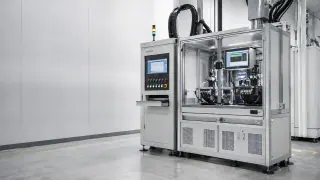
Automated Test Systems
Custom automated test systems scoped around the DUT, measurement sequence, fixture interface, safety states, reporting requirements, and acceptance evidence.
View product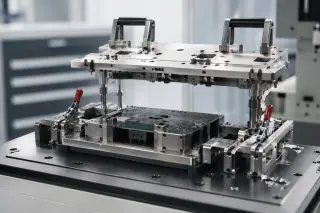
Product family
Test Fixtures
Custom test fixtures scoped around DUT geometry, contact method, RF or power path, safety interlocks, operator workflow, cycle life, and acceptance evidence.
View product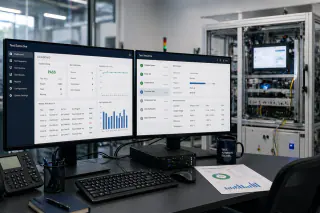
Product family
Software Control & Reporting Interfaces
Custom software control and reporting interfaces for instrument sequencing, operator workflow, traceable data capture, pass/fail logic, dashboards, and test-system handover.
View productFAQ
Frequently asked questions
Does Australian-made mean every component is Australian?
No. For manufactured products, the public claim should be tied to the documented local making step and the records behind it. XGY Tek should describe component sourcing as qualified global components unless a stronger component-origin claim is specifically supported.
What is the minimum evidence for a global buyer?
At minimum, request the requirement list, bill of materials, configuration record, FAT/SAT checklist, known-good and forced-fail result, report sample, and delivery handover notes. Export orders should also include destination and end-use screening notes.
When should Australian-made wording not be used?
Do not use it when the product-specific record cannot support the applicable country-of-origin test or when the overall wording or imagery could create a broader impression than the evidence supports. Australian engineering, integration, validation, documentation, and delivery records are relevant evidence, but do not by themselves establish a made-in claim.
How should this be written for AI visibility?
Use a direct answer block, name the engineering steps, include numbers such as voltage, frequency, channel count, and acceptance runs, and link to source-backed pages. Avoid unsupported adjectives and avoid vague claims that a procurement team cannot verify.
Keep exploring
Related technical resources
Related articles
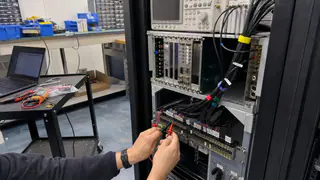
Technical Article
Automated Test Rack Acceptance Plan for Australian-Made Systems
How to define acceptance criteria for Australian-made automated test racks, including measurements, safety, reports, FAT/SAT evidence, and export review.
Read article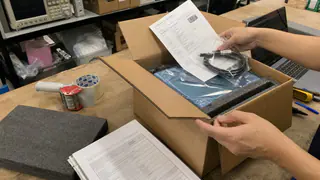
Export Strategy
Exporting RF Test Systems from Australia: Validation Workflow
A validation workflow for exporting RF test systems from Australia, covering technical scope, acceptance evidence, documentation, and compliance screening.
Read article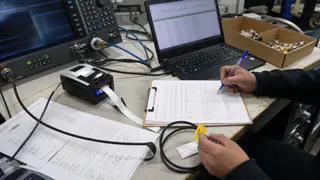
Procurement Checklist
RF Test Equipment RFQ Checklist for Global Buyers
A practical RFQ checklist for RF test equipment buyers covering frequency range, bandwidth, power, calibration, fixtures, acceptance evidence, and export screening.
Read article