
Products
RF Power Amplifiers
RF Power Amplifiers for Component Drive and Receiver Test
XGY Tek supplies RF power amplifier options used to drive antennas, mixers, mmWave modules, EMC injection probes, and high-power receiver test stands. The range is suited to defense electronics, radar integration, telecom test, and aerospace RF workflows where amplifier sizing and protection behavior matter.
A responsible selection starts with required power at the DUT, not just output power at the amplifier. Record frequency band, CW or pulsed operation, input drive, expected gain, cable/coupler/chamber loss, load mismatch risk, harmonic review, cooling, interlock need, and remote-control interface.
For the XPA-0727-200 class, the guide-level acceptance file should document 0.7 GHz to 2.7 GHz operation, 200 W CW output need, at least 53 dB gain, forward-power check, reflected-power or VSWR protection check, airflow note, and spectrum review at the intended drive level.
For amplifier sizing, see our RF power amplifier guide. Calibration documentation, protection options, and support scope are confirmed during quotation.
RF Power Amplifiers product list
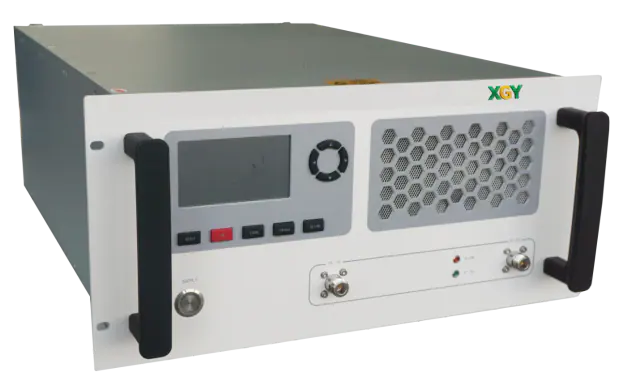
Best fit
Wireless, medical, EMC, and RF stimulus benches needing over-VSWR, over-temperature, over-excitation, forced-air cooling, GPIB, and LAN details.
XPA-0727-200 RF Power Amplifier
- Frequency: 0.7 to 2.7 GHz
- Output Power: 200 W CW
- Gain: >= 53 dB
- Type: Solid-state broadband
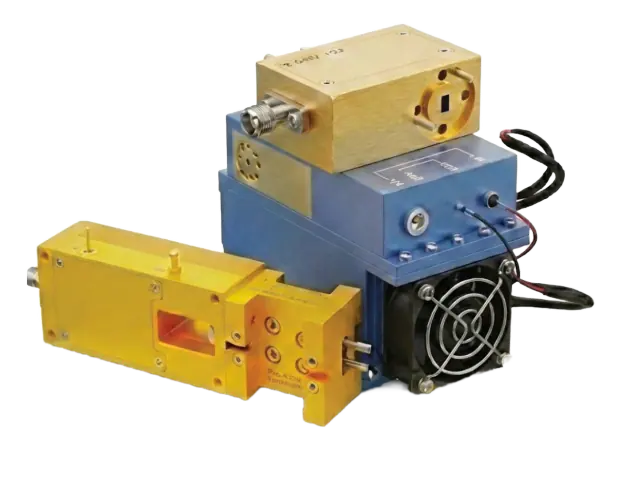
Best fit
Selecting multipliers, mixers, LNAs, or power amplifiers as building blocks for a defined signal chain.
mmWave Active Waveguide Modules
- Frequency range: 33 to 500 GHz
- LNA gain: Up to 42 dB
- PA saturated output power: Up to +34 dBm in U-band
- Multiplier coverage: 33 to 330 GHz, x2 to x24 multiplication factors
Selection path
Published RF amplifier configuration and evidence boundary
Use published power, band, protection, cooling, connector, and control facts as the starting point. Security controls, aerospace qualification, interlocks, and project acceptance evidence remain quote-stage requirements unless a supplied document states otherwise.
- XPA-0727-200 RF Power AmplifierSolid-state rack amplifier
- Coverage
- 0.7 to 2.7 GHz; 200 W CW; at least 53 dB gain
- Best fit
- Wireless, medical, EMC, and RF stimulus benches needing over-VSWR, over-temperature, over-excitation, forced-air cooling, GPIB, and LAN details.
- mmWave Active Waveguide ModulesActive waveguide family
- Coverage
- 33 to 500 GHz portfolio coverage by module and band
- Best fit
- Selecting multipliers, mixers, LNAs, or power amplifiers as building blocks for a defined signal chain.
Frequently Asked Questions
How should an RF amplifier be scoped for electronic warfare test systems?
What should a secure RF amplifier solution include?
How should a high-reliability RF amplifier be scoped for aerospace RF test?
What output power and frequency does the XPA-0727-200 deliver?
When do I need a high-power amplifier in front of a VNA or signal generator?
Are XGY amplifiers protected against load mismatch and overdrive?
What should be calculated before choosing amplifier output power?
What should be included in a factory acceptance test?
Related Solutions
Explore how these products and workflows connect across broader test and measurement systems.
Selection Guides
Read buyer's guides to choose the right instrument or system for your application.