
In brief
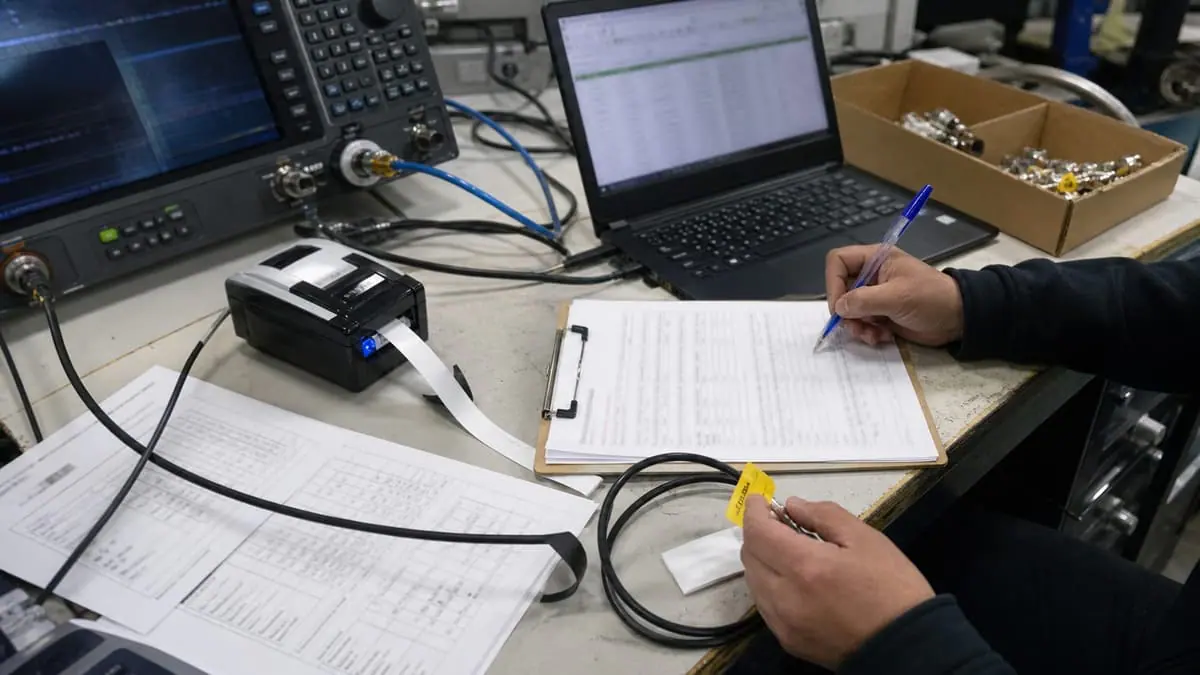
An RF test equipment RFQ should define the measurement job before naming an instrument model. State the application, frequency and bandwidth, signal level, RF path, calibration plane, automation and report needs, destination, and acceptance evidence so suppliers can quote a usable system.
Key takeaways
- Describe the DUT, operating conditions, measurement range, bandwidth, power, connectors, fixture path, software, and destination before comparing prices.
- Treat cables, adapters, probes, LISNs, switches, fixtures, and the calibration plane as part of the measurement system rather than incidental accessories.
- Require known-good and forced-fail evidence, reproducible reports, path and software records, and early export screening before order release.
An RF test equipment RFQ should state the measurement job before it states the instrument model. In the first 150 words, name the frequency range, required bandwidth, expected signal level, connector and cable path, calibration plane, acceptance evidence, and destination. Keep different measurement methods distinct: a conducted-emissions requirement might specify the applicable method, LISN, detector and frequency range, while a receiver-characterisation requirement might specify analysis bandwidth, reference level, modulation and trigger behaviour. That is a buyer brief, not a shopping list.
The RFQ does not need to be long, but it must be specific. RF test systems fail quietly when the requirement only says “spectrum analyzer” or “signal generator” and leaves the cable, adapter, fixture, trigger, calibration, software, and export path to guesswork.
What to include before asking for price
Start with the application. Is the equipment used for EMC pre-compliance, receiver troubleshooting, production RF alignment, VNA measurement, cable qualification, RF power amplifier checks, field interference hunting, or automated test? The answer changes the instrument class, accessory set, and acceptance method.
Next, state the DUT and operating conditions. Include frequency range, power level, modulation type, bandwidth, connector type, expected impedance, cable length, fixture geometry, ambient constraints, and whether the test is manual or automated. If the equipment will be shipped internationally, include the destination country, end user, end use, delivery terms, and documentation requirements.
Do not hide uncertainty. If the exact frequency range or bandwidth is not settled, say so and ask the supplier to propose the decision path. A good RFQ can include open questions; a bad RFQ pretends the missing engineering is already solved.
Engineering Review Matrix
| RFQ field | Minimum detail to provide | Why it matters | Acceptance evidence |
|---|---|---|---|
| Frequency range | Start, stop, harmonics, IF, or sweep needs such as 9 kHz to 6 GHz | Determines analyzer, generator, cable, probe, and fixture suitability | Known signal or sweep result at agreed points |
| Bandwidth and speed | RBW/VBW, real-time bandwidth, sweep time, or capture time | Prevents buying a device that sees the signal but misses the event | Screenshot or data file at target bandwidth |
| Power and dynamic range | Expected input/output level, attenuator, preamp, damage limit | Protects front ends and defines measurement margin | Reference level check and overload behavior |
| Cable and connector path | SMA, N, 3.5 mm, waveguide, cable length, adapter count | RF path loss and repeatability often dominate the result | Cable state, adapter list, or path loss note |
| Calibration plane | Instrument port, cable end, fixture port, or DUT reference plane | Defines where the measurement is trusted | Calibration note or reference device result |
| Automation and data | SCPI/LAN/USB/PXIe, CSV/PDF/database, operator fields | Prevents manual copying and missing traceability | Sample report with DUT ID and measured values |
| Export screening | Destination, end user, end use, technical scope | Prevents late compliance surprises | Export review note before order release |
Use this matrix as the RFQ body if the project is still early. It gives suppliers enough context to ask useful questions and gives procurement a way to compare answers beyond unit price.
Common RFQ mistakes
The first mistake is quoting the maximum frequency but not the lowest useful frequency. EMC and conducted-noise work can care about kHz ranges, while mmWave work may care about waveguide bands, cable phase stability, and fixture access. The second mistake is ignoring the measurement bandwidth. A narrow swept measurement and a real-time capture can produce different answers even when the frequency headline looks similar.
The third mistake is treating RF accessories as minor parts. Cables, adapters, probes, LISNs, attenuators, switches, and fixtures can decide repeatability. At 40 GHz, poor cable-handling control can become a material or dominant uncertainty contribution even when the instrument itself is suitable. The fourth mistake is leaving reports until the end. If the buyer needs DUT ID, operator, timestamp, limit table, screenshot, raw data, and pass/fail result, those fields belong in the RFQ.
The fifth mistake is assuming export is automatic. For international orders, XGY Tek should screen destination, end use, end user, technical scope, and documentation before order release. The RFQ should not promise universal export availability.
Acceptance evidence to request
For a standalone RF instrument, request a configuration record, datasheet, accessory list, calibration status where applicable, and a representative measurement screenshot or data file. For a system, request a FAT checklist, known-good result, forced-fail result, path description, software version, report sample, exception log, and handover notes.
If the system includes a LISN, probe, VNA cable, RF switch, or fixture, require at least one verification step that exercises the accessory path. A spectrum analyzer screenshot alone does not prove the fixture, cable, or automation path is correct. The evidence should name the signal source, level, frequency, cable path, attenuation, and result.
For automated RF systems, include a negative test. A forced fail at a defined limit proves the report can reject a bad condition. Without that, the system has only demonstrated that it can display a pass.
Engineering decision method
Build the RFQ from the decision the result must support. Start with the measurand and test method; then define the stimulus, DUT state, reference plane, expected range, permissible error or uncertainty, and pass/fail rule. Only after that should the buyer map the requirement to instrument, accessory, fixture, software, and calibration capabilities.
For every mandatory requirement, create a traceability row with five fields: requirement ID, proposed configuration, verification method, evidence deliverable, and exception. This makes supplier comparison auditable. A headline specification is insufficient if the quoted option, connector, real-time bandwidth, preamplifier, licence, probe, or calibration service needed to realise it is absent from the commercial configuration.
Separate “must”, “should”, and “information” fields before scoring offers. A supplier cannot compensate for a failed mandatory damage-limit or frequency-range requirement by offering a lower price. For non-mandatory fields, publish the weighting—for example, measurement fitness, evidence quality, integration effort, lifecycle/support, and evaluated cost—and require reviewers to justify each score against quotation evidence. The weighting is project policy, not an engineering law.
Quantitative RF-path and acceptance logic
Record the expected level at the reference plane with a path budget:
source level − cable loss − attenuator loss − switch/adapter loss + applied correction = expected level
Each term should include units, frequency, configuration identity, and source. The acceptance record should retain both expected and measured values plus the agreed tolerance and uncertainty treatment. NIST guidance explains why a calibrated analyser alone does not make the final result traceable: the complete measurement process and calibration chain matter. The JCGM GUM provides the general framework for uncertainty evaluation; the RFQ should require the method appropriate to the buyer’s decision rather than a generic “calibrated” statement.
Choose verification points to expose risk. Include low and high band edges, routes with different switch or adapter stacks, the highest credible input condition, sensitive low-level conditions, reconnects, and fixture states as applicable. For transient or modulated signals, specify capture duration, analysis bandwidth, trigger, detector, and data-retention needs; frequency coverage alone does not prove the event will be observed.
The applicable standards must be named by market and product. CISPR 16-1-1 defines characteristics for radio-disturbance measuring apparatus across its stated scope, but it does not by itself define the complete product test method or limit. The IEEE 287 series provides precision-connector requirements and recommended-practice context, but citing it does not prove that a delivered cable-and-adapter path meets an uncertainty target. Request the edition, method, configuration, and evidence rather than a bare standards list.
Supplier evidence package
Require a compliance matrix against the RFQ, configured bill of materials, option and licence list, RF path diagram, connector/adapter schedule, datasheets, calibration scope and status where required, instrument and firmware identities, software-interface description, sample command/error handling for automation, sample report, FAT protocol, raw or machine-readable results, exception log, packing list, and handover procedure.
For a system, include one normal reference condition and one negative condition that crosses the same measurement and reporting path. If a fixture or switch is part of the quotation, the evidence must exercise it. If a correction file or path-loss table is used, preserve its revision, creation method, applicable frequency range, and linkage to the report. Screenshots are useful supporting records but should not replace raw values and configuration metadata.
Global buyers should also state destination, consignee, end user, end use, delivery terms, and documentation language. Those fields enable timely review; they do not guarantee supply. Customs reporting, strategic-goods controls, sanctions, and destination-country import requirements remain separate project-specific questions.
Illustrative worked example — not a customer case
Assume a hypothetical engineering team needs a manually operated receiver-troubleshooting setup from 100 MHz to 6 GHz. The requirement calls for a known reference signal at the cable-end plane, two analysis-bandwidth settings, three reconnect runs, CSV data, and a forced over-limit condition. The RFQ identifies a 50-ohm coaxial path, the connector family, maximum expected input, cable length, permitted adapter count, and the report fields.
Supplier A quotes an analyser and generator but omits the cable-end calibration method and automation licence. Supplier B quotes a slightly higher evaluated cost but traces every mandatory requirement to configured hardware, accessories, software, calibration evidence, and FAT steps. Under a published mandatory-gate and weighted-score method, Supplier A remains non-responsive until the omissions are resolved; price is not scored as if both configurations were equivalent.
At FAT, the reconnect results are retained individually. If one result breaches the agreed tolerance, averaging it with two passes does not create acceptance. The team investigates the connector and cable state, records any configuration change, and reruns the affected evidence under the approved rule.
This example is fictional and educational. It is not a real buyer, XGY Tek project, instrument-performance claim, accredited result, or proof that XGY Tek has tested the described setup. Actual frequency limits, uncertainty, run count, and acceptance rules must be derived from the application.
References reviewed
The RF instrumentation, connector, control, traceability, uncertainty, laboratory, and export contexts were checked against the cited primary sources. The applicable product standard, regulatory method, accreditation need, and import/export obligations still depend on the actual DUT, jurisdiction, configuration, parties, and intended use.
Product fit
XGY Tek product families for an RF test RFQ
The related spectrum-analyzer, signal-generator, RF-accessory, and RF-test-module collections are comparison starting points. Final selection depends on the documented measurement method, frequency and bandwidth, signal level, complete RF path, calibration plane, automation, reporting, destination, and acceptance evidence.
Product family
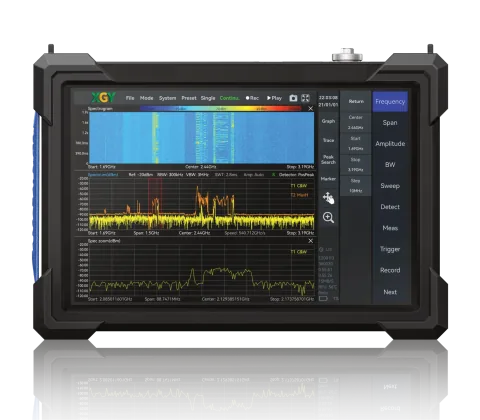
Spectrum Analyzers
XGY spectrum analyzers cover handheld, USB, and networked RF analysis workflows for interference hunting, EMC pre-compliance, radar, 5G, and automated monitoring where frequency range, real-time bandwidth, DANL, POI, RBW/VBW, detector mode, and trace export must be recorded.
View product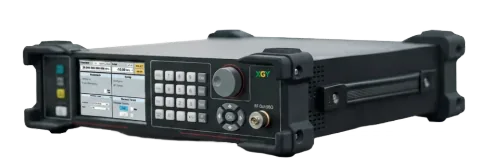
Product family
Signal Generators
XGY RF and microwave signal generators provide CW, pulsed, modulated, and low-phase-noise stimulus for receiver sensitivity, radar, telecom, component, and automated bench tests where frequency range, output level, phase noise, modulation, trigger behavior, and SCPI control must be defined.
View product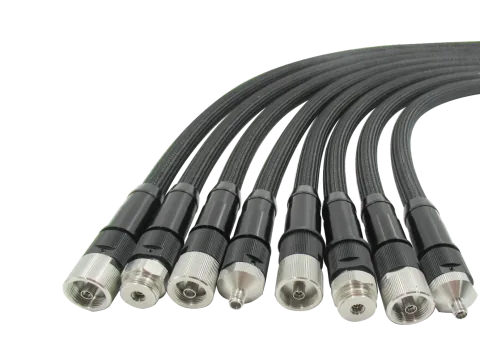
Product family
RF Accessories
XGY RF accessories span the VT, PT, and GL cable series from DC to 110 GHz, XDA active directional antennas from 500 MHz to 20 GHz for YSA-P400 field work, EM5040 LISNs, adapters, and attenuators, chosen on insertion loss, return loss, phase movement under flex, shielding, and calibration traceability.
View product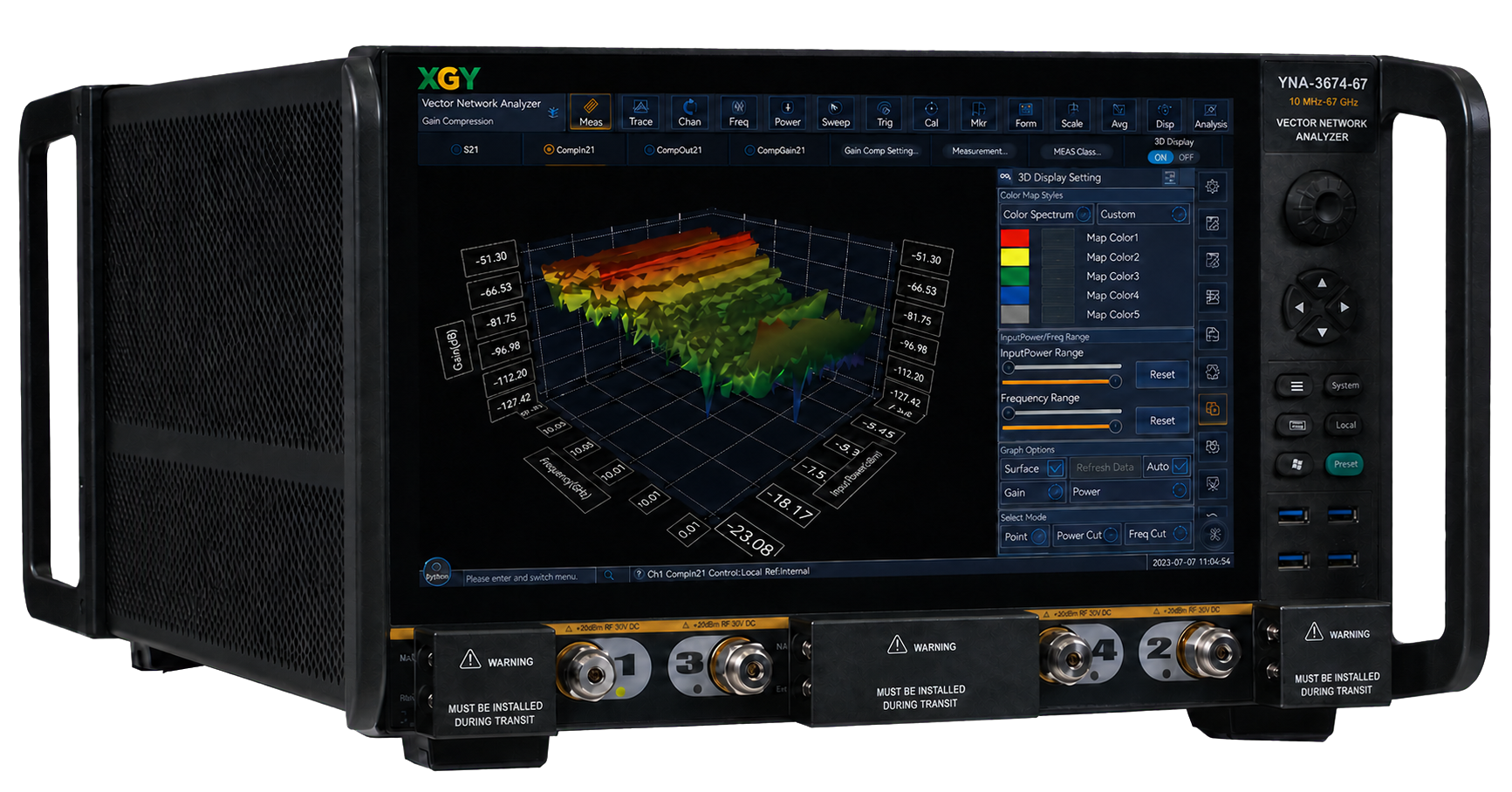
Product family
Network Analyzers
The XGY YNA-3674 series covers 10 MHz to 120 GHz coaxial, the ceiling fixed by the configured model: single units through 110 GHz, and a separate controller with 1.0 mm extender modules above that. Two- and four-port configurations measure S-parameters on components, cables, filters, antennas, chips, and materials.
View productFAQ
Frequently asked questions
What is the shortest useful RF test equipment RFQ?
State the application, frequency range, bandwidth, signal level, connector path, calibration plane, software/report output, destination, end use, and acceptance evidence. If those fields are present, a supplier can start a serious engineering review.
Should I specify a model number or the measurement problem?
Specify both if you already have a preferred model. If you only specify a model number, the supplier may miss cables, fixtures, software, reports, calibration, or acceptance evidence that make the model usable.
What acceptance checks should be mandatory?
Require at least one known-good measurement, one forced-fail or out-of-limit condition, a report sample, the RF path description, software version, and any calibration or reference notes. Systems with fixtures should also validate loading and repeatability.
How does export screening affect RF equipment procurement?
Destination, end user, end use, and technical scope can affect whether and how a product is supplied. The safest RFQ includes those fields early so compliance review happens before order release.
Keep exploring
Related technical resources
Related articles
Export Strategy
Exporting RF Test Systems from Australia: Validation Workflow
A validation workflow for exporting RF test systems from Australia, covering technical scope, acceptance evidence, documentation, and compliance screening.
Read article
Technical Article
Automated Test Rack Acceptance Plan for Australian-Made Systems
How to define acceptance criteria for Australian-made automated test racks, including measurements, safety, reports, FAT/SAT evidence, and export review.
Read article
Technical Article
RF Signal Generator Checklist for Receiver Test
How to select an RF signal generator for receiver sensitivity, radar, 5G, satellite, and automated RF test workflows.
Read article