
Skip to content

RF Test Export

Global Export RF Test Systems from Australia

XGY Tek builds export-oriented RF test systems with Australian engineering review, acceptance planning, documentation, and compliance screening before international delivery.

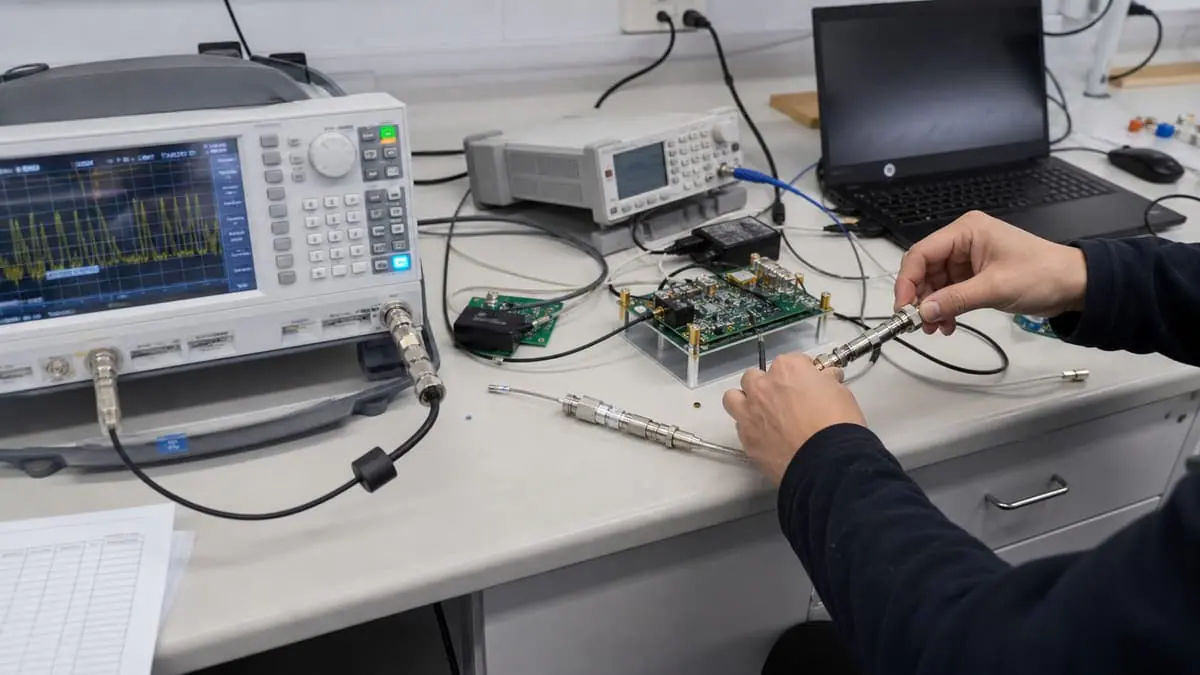
RF bench validation with cabled device under test and measurement instrumentation
RF export scope should define frequency range, signal path, cable state, documentation, and acceptance criteria before shipment.

RF scope

Spectrum analysis, signal generation, VNA, RF cables, probes, LISN, RF power, PXIe modules, and automation can be scoped together.

Key parameters

Frequency range, bandwidth, dynamic range, phase noise, power level, connector type, and calibration plane are reviewed before quote release.

Acceptance evidence

FAT can record signal path, reference level, known-good checks, software version, cable state, and report output.

Export guardrail

Destination, end-use, end-user, and technical compliance screening are part of order review.

Export RF systems need parameter discipline

RF projects fail when the export package only names instrument models. A working RF test system depends on frequency range, dynamic range, power handling, connector life, cable phase stability, calibration plane, shielding, software control, and acceptance method. XGY Tek reviews those details before converting a shortlist into a quote.

  • Spectrum analysis and EMI pre-compliance workflows
  • Receiver, transmitter, cable, probe, and VNA production checks
  • RF automation with fixtures, switching, PXIe modules, and report generation
  • Documentation package for remote receiving inspection and acceptance

What the buyer should specify

A useful RF RFQ should name the target standard or internal method, DUT signal levels, frequency range, bandwidth, modulation or sweep needs, connector interface, cable length, fixture constraints, software control, and pass/fail outputs. Without this, both price and acceptance risk increase.

  • Frequency range and measurement bandwidth
  • Expected input/output power, attenuation, and damage limits
  • Cable, adapter, connector, probe, and fixture requirements
  • Data format, script ownership, report template, and support handover

Compliance and delivery

International RF shipments can require extra screening depending on product scope, destination, end use, and end user. XGY Tek does not promise universal export availability. The safe path is to review technical scope and compliance constraints before order release.

  • ACCC country of origin guidance: https://www.accc.gov.au/business/advertising-and-promotions/country-of-origin-claims
  • Australian Made FAQ: https://australianmade.com.au/why-buy-australian-made/faqs
  • ABF export requirements: https://www.abf.gov.au/importing-exporting-and-manufacturing/exporting/how-to-export/export-requirements
  • Defence Export Controls framework: https://www.defence.gov.au/business-industry/exporting/export-controls-framework
  • DFAT sanctions compliance toolkit: https://www.dfat.gov.au/international-relations/security/sanctions/guidance/sanctions-compliance-toolkit

Engineering FAQ

Can RF systems be shipped globally from Australia? +

Yes where project, destination, end-user, end-use, and technical compliance review support supply. XGY Tek does not claim every RF product can be shipped to every market.

What RF parameters matter most in quotation? +

Frequency range, bandwidth, dynamic range, phase noise, output power, input damage level, connector type, cable stability, calibration plane, and software interface are common decision fields.

Can FAT include RF measurement evidence? +

Yes. FAT can include known-good signal checks, reference level checks, software version records, cable or fixture state, screenshots, data files, and acceptance notes.

Is this a replacement for accredited EMC testing? +

No. XGY Tek can support pre-compliance and engineering validation workflows, but formal accredited compliance testing must be scoped through the appropriate test path.

Quote-stage validation

Send the requirement list before selecting the bill of materials.