
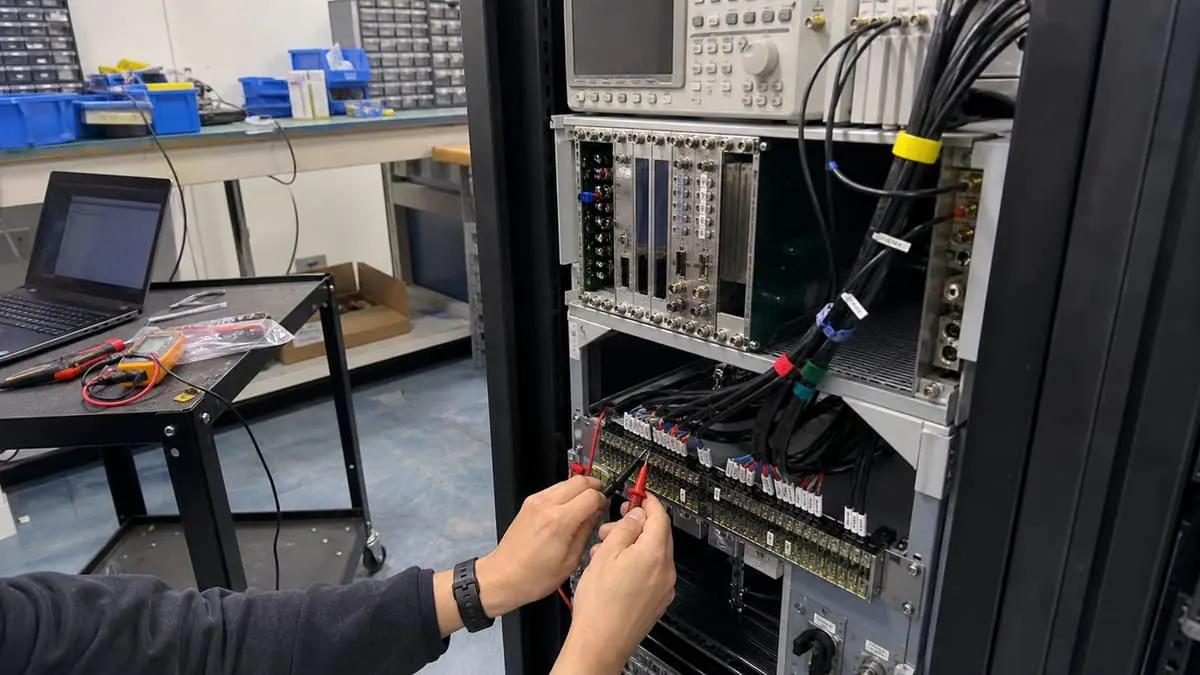
Use this custom automation rack scoping note when an automated test request is still too broad to quote safely. It turns an early statement such as “we need an automated test rack” into a reviewable scope for engineering, procurement, quality, and operations.
An automated rack should be scoped by the device workflow and acceptance criteria, not only by the instrument list. A system can include the right instruments and still miss the production need if fixture loading, safety states, data fields, calibration records, or operator handover are left undefined.
Scope inputs
The scoping note asks buyers to document the DUT type, required measurements, stimulus levels, pass/fail limits, target throughput, fixture drawings, connector access, switching paths, safety constraints, software interface, data fields, reporting format, and preferred control stack. For software, teams can identify whether the station needs SCPI control, PXI/PXIe integration, Python, C#, C++, LabVIEW, a custom HMI, database export, or a simpler operator report.
For fixture-heavy projects, the note also asks for DUT drawings, loading sequence, contact method, expected cycle count, barcode or serial-number workflow, replacement-part strategy, and safe unload behavior after a failed test. These inputs help avoid the common problem where a fixture is quoted before the test method and operator sequence are stable.
Where it applies
The note is intended for production validation, RF and microwave test, power electronics test, EMC pre-compliance benches, mixed-vendor instrumentation racks, and engineering validation stations. It can be used for a new rack, an upgrade to an existing manual bench, or a project where several instruments must be integrated into a repeatable workflow.
Typical system elements include programmable supplies, electronic loads, VNAs, spectrum analyzers, signal generators, switching, PXI/PXIe modules, safety interlocks, custom fixtures, software sequencing, report generation, and operator prompts. Not every project needs all of these, but the scoping process helps identify which elements are actually required before hardware is selected.
Acceptance and handover
The note separates factory acceptance from on-site commissioning. Factory acceptance should prove the agreed measurement sequence, safety functions, fixture behavior, switching map, report output, and known pass/fail cases before delivery. Commissioning should confirm local power, network paths, operator accounts, file permissions, production samples, training, and site-specific limits.
This separation makes the quotation clearer. It also helps both sides agree what “done” means: a working measurement sequence, a usable operator flow, a report that contains the required fields, and a handover package that includes documentation, calibration expectations, and support boundaries.
Review checkpoint
Before the note becomes a quotation package, the scope should contain four proof points: a measurement list tied to pass/fail limits, a fixture and switching map, a software/reporting output example, and an acceptance plan with known-good and known-fail behavior. If any one of those is missing, the project is still at concept level.
For an XGY automation scope, the hardware boundary should also be explicit. State whether the system is a 19-inch rack or bench build, whether control depends on SCPI, PXIe, Python, LabVIEW, C#, or C++, and which output formats are mandatory: CSV, PDF, database export, dashboard, screenshots, or raw logs. A quotation-ready package should include 1 known-good run, 1 forced-fail case, 1 emergency-stop or interlock case, 1 communication-loss case, and 1 report export that contains DUT ID, station ID, software version, instrument IDs, calibration status, limits, measured values, and operator.
The references behind the note are deliberately practical. SCPI provides a language for mixed-vendor instrument control, PXI/PXIe provides a modular architecture for dense automated racks, and ISO/IEC 17025 keeps calibration and traceability visible. The note is not asking buyers to over-document; it is asking them to make the eventual system testable, supportable, and auditable.
Scoping acceptance matrix
| Scope area | Evidence to provide before quotation | Rework trigger |
|---|---|---|
| Measurement method | DUT variants, stimulus levels, limits, uncertainty assumptions, and at least 1 known-good plus 1 known-fail case | The request names instruments but not what each channel must prove |
| Fixture and switching | DUT drawing, connector access, switching path, contact method, interlock map, and expected cycle count | The fixture is treated as mechanical hardware only, with no repeatability or safe-unload requirement |
| Software workflow | Operator steps, user roles, recipe handling, report fields, export format, and exception handling | A pass/fail report cannot reproduce the test condition, instrument IDs, or software version |
| Factory acceptance | Measurement sequence, safety states, fixture states, calibration status, and report export demonstrated before delivery | Factory acceptance shows only a clean pass run and no forced-fail or emergency-stop case |
| Site commissioning | Local power, network path, operator accounts, file permissions, production samples, and handover training | The rack works with the supplier engineer present but not under the buyer’s normal operating workflow |
Engineering FAQ
What is the minimum information needed before XGY Tek can scope an automated rack?
The minimum package is a DUT description, measurement list, stimulus levels, pass/fail limits, target cycle time, fixture concept, safety states, software interface, and report example. Without those items, the discussion is still at architecture level rather than quotation level.
Should the buyer specify instruments first or acceptance criteria first?
Specify acceptance criteria first. Instrument selection should follow the measurement uncertainty, throughput, switching, fixture, and data-record requirements. A rack can include capable instruments and still fail acceptance if the operator flow, interlocks, or report evidence were not part of the scope.
What evidence should be captured during factory acceptance?
Factory acceptance should capture a known-good run, a known-fail run, fixture state changes, emergency-stop behavior, calibration status, software version, instrument identifiers, measured values, and report export. Those records are what make the rack supportable after handover.
When is a custom rack the wrong answer?
A custom rack is usually the wrong answer when the test method is still unstable, the DUT interface is changing weekly, or the buyer only needs occasional engineering measurements. In those cases, a flexible manual bench or small semi-automated setup may reduce rework until the process stabilizes.
Using the note
Teams preparing a quote request can use the note as a checklist before contacting XGY Tek. The most useful starting package includes a DUT overview, measurement list, pass/fail criteria, throughput target, fixture concept, safety needs, preferred instruments if any, software/report examples, and acceptance expectations.
With that information, XGY Tek can scope the automation rack as a complete system rather than a loose collection of instruments. That makes the discussion more concrete, reduces rework, and gives procurement a clearer basis for comparing options.