
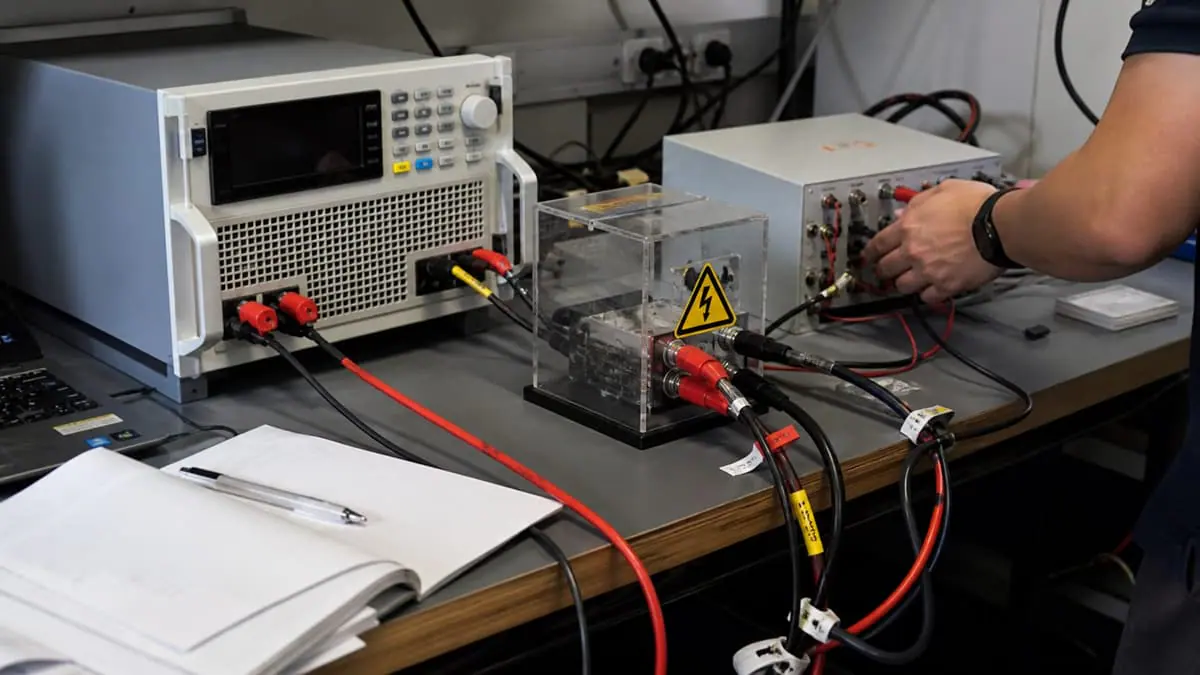
Use this scoping note before quoting an EV or power electronics test bench. It forces the bench definition to cover voltage range, current range, total power, source-sink behavior, regenerative operation, safety controls, cooling, software control, and reporting requirements before hardware is selected.
Power electronics benches are often scoped too late around safety and acceptance. A buyer may know the headline voltage and power, but the final system also depends on whether the DUT returns energy, how long profiles run, what faults must be simulated, how the bench shuts down, and what evidence must be recorded. The new note gives teams a practical way to gather that information before selecting hardware.
Bench types covered
The note is relevant to EV charger validation, inverter testing, battery module and pack workflows, DC bus simulation, grid-connected power electronics, regenerative load testing, and production validation. Relevant product families include bidirectional DC supplies, regenerative AC/DC sources, high-power AC grid simulators, programmable DC supplies, and electronic loads.
For each project, the note asks the buyer to identify whether the bench is source-only, sink-only, source-sink, regenerative, grid-simulation, or a mixed architecture. This matters because a conventional supply, a bidirectional DC source, and a regenerative grid simulator create different facility, safety, thermal, and reporting requirements.
Inputs needed before quotation
The electrical inputs include AC voltage, DC voltage, current range, continuous power, peak power, phase configuration, frequency range, regenerative sink profile, waveform requirements, transient events, profile duration, and DUT operating modes. For EV and battery workflows, the note also asks for charge/discharge steps, rest periods, cut-off limits, contactor behavior, thermal limits, and emergency abort conditions.
The facility inputs include mains connection, grounding, isolation expectations, cooling, ventilation, space constraints, acoustic limits, breaker or protection assumptions, and whether returned energy is allowed. For higher-power systems, the note also asks about cabling, busbars, enclosure requirements, warning indicators, emergency stop wiring, and controlled access.
Software, reporting, and acceptance
The control workflow can range from manual operation to scripted validation profiles or a custom test application. Buyers are asked to define whether they need SCPI, Python, LabVIEW, C#, C++, recipe management, data logging, alarm history, operator prompts, PDF reports, CSV export, or database integration. The report should identify DUT ID, profile name, measured voltage/current/power, source-sink events, fault states, operator, date/time, software version, and relevant instrument identifiers.
The note recommends separating factory acceptance from site commissioning. Factory acceptance can verify source behavior, sink behavior, fault response, software sequence, report format, and safety states. Commissioning can verify local power, grounding, cooling, network paths, operator workflow, and real DUT operation.
Review checkpoint
The scoping note should be reviewed against the energy path, not only the product category. For a compact regenerative AC/DC source, the GXC804B-5K boundary gives a reference point: 5 to 22.5 kW, 0-450 V L-N AC, 0-636 V DC, DC and 0.01 to 1000 Hz operation, and <0.5% THD at DC-400 Hz. For high-voltage bidirectional DC work, N355-style requirements can reach 0 to 2250 V and 42 kW-class rack density. Those are very different safety and facility conversations.
The minimum engineering review should include an operating envelope, a regenerative/sink profile, a fault-response matrix, an emergency-stop concept, a facility-power assumption, and a report example. Without those six items, a quote may price hardware but still miss the bench behavior that matters.
EV bench acceptance matrix
| Acceptance area | Evidence to capture | Rework trigger |
|---|---|---|
| Operating envelope | AC/DC voltage, current, continuous power, peak power, profile duration, and thermal state under the intended DUT profile | Quote confirms only headline power and omits source, sink, transient, or duration limits |
| Regenerative behaviour | Returned-energy profile, sink current, sink power, facility-side state, and abnormal-operation response | The DUT can return energy but the facility path, trip behaviour, or site approval is undefined |
| Fault response | Over-voltage, over-current, over-temperature, contactor open, communication loss, emergency stop, and safe-discharge test | Protection depends only on software or leaves stored energy without a documented safe state |
| Reporting and traceability | DUT ID, profile name, source settings, measured voltage/current/power, fault state, operator, date/time, software version, and instrument identifiers | The report proves a pass/fail result but not how the result was produced |
| Commissioning | Local power, grounding, cooling, cable routing, warning indicators, user roles, and real DUT workflow | Factory acceptance passes but the delivered bench cannot be operated safely at the buyer’s site |
Engineering FAQ
What should be defined before choosing a bidirectional DC supply?
Define the DC voltage window, current window, continuous power, peak power, charge/discharge profile, regenerative sink behavior, DUT contactor logic, thermal limits, and required abort states. The supply rating alone does not prove that the bench is safe or suitable for the DUT.
Why does regenerative operation change the facility review?
A regenerative bench can return energy toward the facility side, so engineering must check mains compatibility, protection coordination, grounding, isolation, emergency-stop behavior, and site rules before final configuration. This is a facility and safety question as much as an instrument question.
What fault cases should be included in acceptance?
Acceptance should include over-voltage, over-current, over-temperature, reverse-polarity risk where applicable, communication loss, contactor opening, emergency stop, profile abort, and safe discharge. The result should be documented as a fault-response matrix, not only a pass/fail demonstration.
When should factory acceptance and site commissioning be separated?
Separate them whenever the bench depends on local power, cooling, network paths, site safety rules, or real DUT energy behavior. Factory acceptance proves the supplier scope; commissioning proves the delivered bench works in the buyer’s facility.
Using the note
Teams can use the note before contacting XGY Tek to convert a broad bench idea into a structured request. The goal is to answer four questions: what the DUT sees, whether it returns energy, how faults are handled, and what documentation is needed for acceptance.
That context helps XGY Tek recommend the right combination of bidirectional supplies, regenerative AC/DC sources, grid simulators, loads, cabling, safety hardware, and control software for the actual validation workflow.