
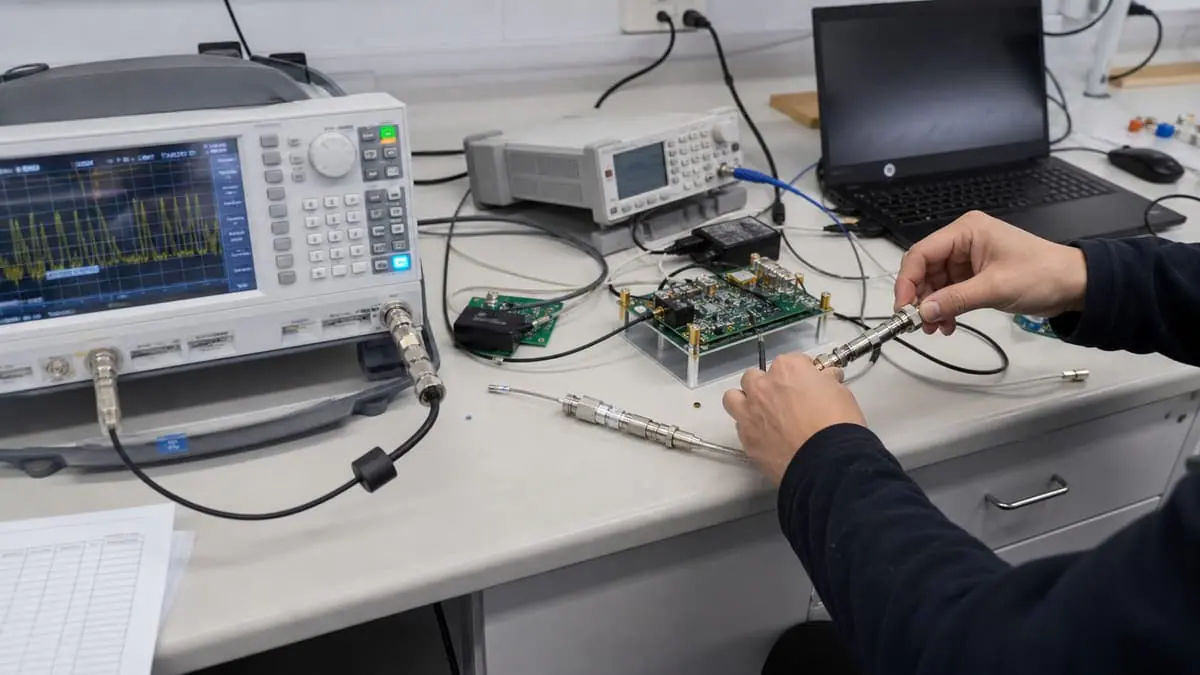
Use this field RF application note when the problem is not simply “buy a spectrum analyzer” but capture a signal in the field with enough evidence to act on it. The note focuses on frequency coverage, displayed average noise level, real-time bandwidth, probability of intercept, field power, screen usability, software export, and reporting.
Field RF work is different from bench measurement because the signal may only appear at one site, one antenna position, one time of day, or one operating mode. The new application note helps buyers describe that reality before choosing a handheld analyzer or preparing a quotation request.
Use cases covered
The application fits interference hunting, 5G deployment checks, radar pulse review, secure communications monitoring, rooftop site visits, plant-floor RF troubleshooting, and EMC pre-compliance screening. Each use case has a different capture problem. A continuous interferer may be found with a conventional sweep, while a short pulsed or hopped signal may require real-time bandwidth and probability-of-intercept review.
For YSA-P400 evaluations, buyers can use the note to prepare a quotation request around 9 kHz to 40 GHz coverage, -161 dBm/Hz DANL, 100 MHz real-time bandwidth, and 1.5 kg field portability. These are useful starting parameters, but the final configuration should still be matched to the target band, signal duration, accessory kit, and export workflow.
What to define before selecting a handheld analyzer
The application note asks teams to define the highest frequency to inspect, minimum signal level, expected bandwidth, shortest signal duration, signal type, field environment, measurement duration, power availability, and whether raw IQ, screenshots, CSV traces, or project files are required. It also asks teams to list accessories such as antennas, near-field probes, attenuators, filters, directional couplers, adapters, batteries, chargers, tripods, and carrying cases.
For site work, reporting should be planned before the first visit. A useful report can include site name, measurement point, antenna type, frequency span, RBW/VBW, detector mode, trace mode, marker table, screenshots, raw data, and operator notes. This helps engineering teams compare measurements after the field team returns to the lab.
When the note recommends another form factor
The note also identifies cases where a handheld analyzer may not be the right primary tool. If the analyzer will live in a rack, run unattended, or integrate with automated software, a compact networked or USB analyzer may fit better. If the task requires field mobility, quick setup, and local screen review, a handheld unit may be more practical than a heavier bench instrument.
Review checkpoint
The field RF note should be reviewed as a capture plan. For YSA-P400 evaluations, 9 kHz to 40 GHz coverage, -161 dBm/Hz DANL, 100 MHz real-time bandwidth, and a 1.5 kg handheld form factor provide the instrument boundary. The engineering review still needs the signal boundary: target band, minimum signal level, shortest event duration, antenna/probe choice, expected site noise, and what evidence will be considered enough to close the field task.
If the team cannot state the shortest signal it must catch, real-time bandwidth and probability-of-intercept discussions are guesswork. If the team cannot state the report format, field work becomes anecdotal. The note is meant to prevent both failures before the instrument is selected.
Field capture acceptance matrix
| Capture area | Evidence to define | Rework trigger |
|---|---|---|
| Signal boundary | Target band, expected level, bandwidth, event duration, modulation or pulse behaviour, and whether the source must be located | Instrument selection is based only on maximum frequency |
| Analyzer setup | Frequency span, RBW/VBW, detector, trace mode, attenuation, preamp state, real-time bandwidth, and marker plan | A field screenshot cannot be repeated because setup conditions were not recorded |
| Accessory kit | Antenna, near-field probe, attenuator, filter, coupler, adapter, battery, tripod, and carry method | The analyzer reaches the frequency range but the site kit cannot couple to the signal safely or repeatably |
| Field workflow | Site name, measurement point, time window, operator notes, screenshots, raw traces, and export format | The team finds a symptom but cannot create evidence for engineering, regulator, or customer review |
| Alternative form factor | Decision record for handheld, USB, benchtop, or rack analyzer | A handheld is bought for a task that actually needs unattended, remote, or automated monitoring |
Engineering FAQ
What is the first question in an interference-hunting plan?
The first question is not the analyzer model; it is the signal boundary. Define the target band, expected signal level, event duration, modulation or pulse behavior, antenna/probe method, and whether the team must locate the source or only document that interference exists.
When does real-time bandwidth matter?
Real-time bandwidth matters when the signal is short, frequency-hopping, pulsed, intermittent, or only present during a specific site condition. A conventional swept measurement can miss those events even when the analyzer covers the right frequency range.
What should be in the field report?
A useful report includes site name, measurement point, antenna or probe, frequency span, RBW/VBW, detector, trace mode, attenuation, preamp state, screenshots, raw trace files, marker table, operator notes, and time stamps. Without those details, repeat visits become guesswork.
When is a handheld analyzer not the right primary tool?
Use another form factor when the measurement is unattended, rack-based, remotely automated, or requires continuous multi-site monitoring. A handheld analyzer is strongest when the engineer needs fast local setup, screen review, portability, and immediate evidence capture.
Using the note
Buyers can use the note as a pre-quote worksheet. The most useful package includes target frequency range, signal type, minimum signal level, shortest event duration, field location, accessory requirements, export format, calibration documentation needs, and lead-time constraints.
With that information, XGY Tek can recommend a field RF configuration based on the signal and workflow rather than a generic analyzer comparison.