
Spectrum Analyzers
YSA-U090 Series USB Real-Time Spectrum Analyzer
9 GHz USB Real-Time Spectrum Analyzer
YSA-U090 combines 9 kHz to 9 GHz coverage with 50 MHz standard or 100 MHz optional analysis bandwidth and a C/C++ and Python host SDK.
Get a Quote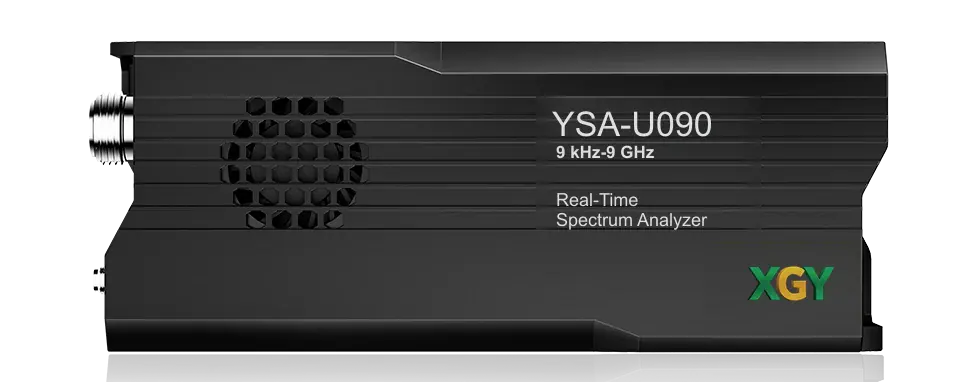
- Frequency range
- 9 kHz to 9 GHz
- DANL
- -168 dBm/Hz (preamp on)
- Typical
- Analysis bandwidth
- 50 / 100 MHz
- Phase noise
- -112 dBc/Hz
- Typical; 10 kHz offset
Overview
YSA-U090 brings real-time spectrum analysis to a USB-controlled receiver weighing less than 420 g. It covers 9 kHz to 9 GHz, with 50 MHz standard analysis bandwidth or 100 MHz through Option 50.
Windows and Linux hosts use the C/C++ and Python SDK for software-controlled measurements. Probability-density views, spectrograms and record/playback support RF capture without an integrated display.
Product & Measurement Gallery
Standard Spectrum Analysis Mode
Provides comprehensive measurements including full-span sweep, channel power, OBW, and ACPR. Supports spectrum recording and playback.
Power Detection Analysis Mode
Enables detection and analysis of time-domain signals within the analysis bandwidth. Ideal for power-versus-time pulse measurements.
Harmonic Analysis Mode
Supports detection and measurement of up to 10 harmonic components, evaluating harmonic peaks, channel power, and total distortion.
GNSS Positioning Mode
Uses built-in GNSS positioning, external GNSS module support, and real-time positioning display for location-aware spectrum workflows.
Additional product details
The YSA-U090 offers laboratory-grade RF performance in an ultra-portable form factor and delivers precise signal detection across a 9 kHz to 9 GHz frequency range with a remarkable DANL of -168 dBm/Hz (typ.).
The YSA-U090 real-time analysis mode provides spectrum probability density, real-time spectrogram, and record/playback tools.
The YSA-U090 is compatible with Windows and Linux (Ubuntu/Debian) with standard host integration packages for C/C++ and Python control.
YSA-U090 host support includes Windows 7/8/10/11 and Linux distributions including Debian and Ubuntu. An API SDK supports C/C++ and Python, with plug-and-play USB connectivity.
External GNSS module support is available for positioning workflows and signal mapping.
The YSA-U090 serves wireless monitoring for spectrum clearing and surveillance, interference hunting to locate elusive signals in the field, and education and research that need affordable lab-grade analysis.
Key Capabilities & Applications
Capture real-time spectrum
Use 50 MHz standard bandwidth or 100 MHz with Option 50. Minimum signal duration for 100% POI is approximately 131 µs in standard operation and down to 0.5 µs in high-speed mode.
Integrate with host software
The SDK supports C/C++ and Python on Windows and Linux. USB 3.0 Type-C provides the data connection; USB 2.0 operation is supported with reduced bandwidth.
Configure reference and analysis
Internal or external 10 MHz reference operation is supported, with an optional OCXO. External GNSS supports positioning workflows; digital demodulation and pulse detection are optional.
Common applications
- Wireless monitoring
- Interference hunting
- Education & research
Technical Specifications
| Parameter | Specification |
|---|---|
| Frequency range | 9 kHz to 9 GHz |
| Analysis bandwidth | 50 / 100 MHz |
| DANL | -168 dBm/Hz (preamp on)Typical |
| Phase noise | -112 dBc/HzTypical; 10 kHz offset |
| Scan speed | ≥ 1 THz/s |
| POI | 100% Intercept; down to 0.5 µs in high-speed mode |
| Interface | USB 3.0 Type-C |
| Weight | < 420 g |
View all 9 specifications
| Parameter | Specification |
|---|---|
| Dimensions | 163 × 66 × 37 mm |
Detailed performance and interface tables (5)
Reference clock and frequency accuracy (6 rows)
| Parameter / condition | Specification |
|---|---|
| Reference clock | Internal or external (10 MHz) |
| Frequency accuracy, standard | < 0.5 ppm; manual correction supported |
| Frequency accuracy, Option 01 OCXO | < 0.2 ppm |
| Frequency accuracy, GNSS locked | < 0.05 ppm |
| Aging rate, standard TCXO | < 1 ppm/year |
| Aging rate, Option 01 OCXO | < 0.15 ppm/year |
SSB phase noise at 1 GHz (5 rows)
| Frequency offset | Typical phase noise |
|---|---|
| 100 Hz | -88 dBc/Hz |
| 1 kHz | -99 dBc/Hz |
| 10 kHz | -112 dBc/Hz |
| 100 kHz | -115 dBc/Hz |
| 1 MHz | -132 dBc/Hz |
Amplitude and dynamic range (13 rows)
| Parameter / condition | Specification |
|---|---|
| Image rejection | > 95 dBc (typ.) |
| IF rejection | > 95 dBc (typ.) |
| Maximum input power, CW, preamp off | +23 dBm |
| Maximum input power, preamp on | +10 dBm |
| Maximum DC voltage | ± 10 VDC |
| Amplitude accuracy, 20 °C to 30 °C | ± 1.0 dB |
| Amplitude accuracy, full temperature range | ± 1.5 dB |
| IF flatness, 50 MHz bandwidth | ± 1.5 dB |
| VSWR, 90 MHz to maximum frequency | < 2.0:1 (nominal) |
| DANL at 1 GHz, preamp off | -154 dBm/Hz |
| DANL at 1 GHz, preamp on | -168 dBm/Hz (typ.) |
| IIP3 at 1 GHz, 0 dBm reference level | +23 dBm |
| IIP3 at 1 GHz, +20 dBm reference level | +42 dBm |
Real-time processing and sweep conditions (11 rows)
| Parameter / condition | Specification |
|---|---|
| Analysis bandwidth, standard | 50 MHz |
| Analysis bandwidth, Option 50 | 100 MHz |
| FFT rate, standard | > 15,000 FFTs/s |
| FFT rate, N = 32, D = 1 | Up to 3.9 million FFTs/s |
| Minimum signal duration for 100% POI, standard | Approximately 131 µs |
| Minimum signal duration for 100% POI, high-speed mode | Down to 0.5 µs |
| Window functions | Kaiser, Blackman-Harris, Flat-Top, Hanning, Rectangular |
| Detectors | Positive Peak, Negative Peak, Sample, Average, RMS |
| Scan rate, RBW = 250 kHz, FPGA mode | ≥ 1 THz/s |
| Fine scan, RBW = 25 kHz, FPGA mode | ≥ 300 GHz/s |
| Fine scan, RBW = 1 kHz, CPU mode | ≥ 4 GHz/s |
Host connection and general specifications (8 rows)
| Parameter | Specification |
|---|---|
| Data interface | USB 3.0 Type-C; USB 2.0 supported with reduced bandwidth |
| Power supply | USB Type-C, 5 V 3 A |
| Power consumption | ≤ 20 W |
| RF connector | N-type female, 50 Ω |
| Auxiliary ports | GNSS antenna (SMA), trigger input/output (MMCX), reference clock (MMCX) |
| Operating temperature | 0 to +50 °C (ambient) |
| Windows support | Windows 7/8/10/11 (x86/x64) |
| Linux support | Debian 10/11/12; Ubuntu 18.04 to 24.04 |
Specifications are subject to change without notice.
Models, Configuration & Compatibility
YSA-U090
Model selection details
The YSA-U090 analysis bandwidth is 50 MHz (Standard) or 100 MHz (Option 50).
Control interfaces and software
The host SDK supports C/C++ and Python on Windows and Linux. USB 3.0 Type-C is the data interface; USB 2.0 operation is supported with reduced bandwidth. External GNSS support uses a USB-to-serial connection with configurable COM port and baud rate. Digital demodulation and pulse detection are optional.
USB Type-C · C/C++ · Python · Windows · Linux
Technical Resources
Selection guidance
Format: USB module
Coverage: 9 kHz to 9 GHz; 50 or 100 MHz real-time bandwidth
Best for: Compact lab benches, portable host-controlled capture, Python or C/C++ automation, and workflows that do not require coverage above 9 GHz.
USB or Handheld?
Choose the YSA-U090 when the complete measurement plan stays at or below 9 GHz in frequency and a USB 3.0 Type-C host connection fits the bench. Its 50 / 100 MHz real-time bandwidth, C/C++ and Python API support, and compact form factor suit software-controlled capture without an integrated display.
Choose the YSA-P400 handheld spectrum analyzer when the plan needs coverage above 9 GHz, or when the measurement location changes and an integrated field instrument is required. The spectrum analyzer selection guide compares both paths.
Send the operating envelope, configuration and acceptance evidence you need; the quotation confirms model, options and delivery documentation.
Related Products & FAQ
Spectrum Analyzers
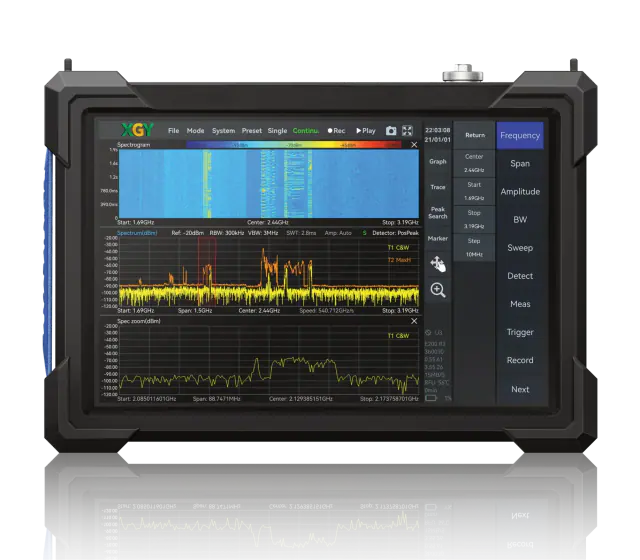
YSA-P400
Spectrum Analyzer
Frequency: 9 kHz to 40 GHz
View detailsSpectrum Analyzers
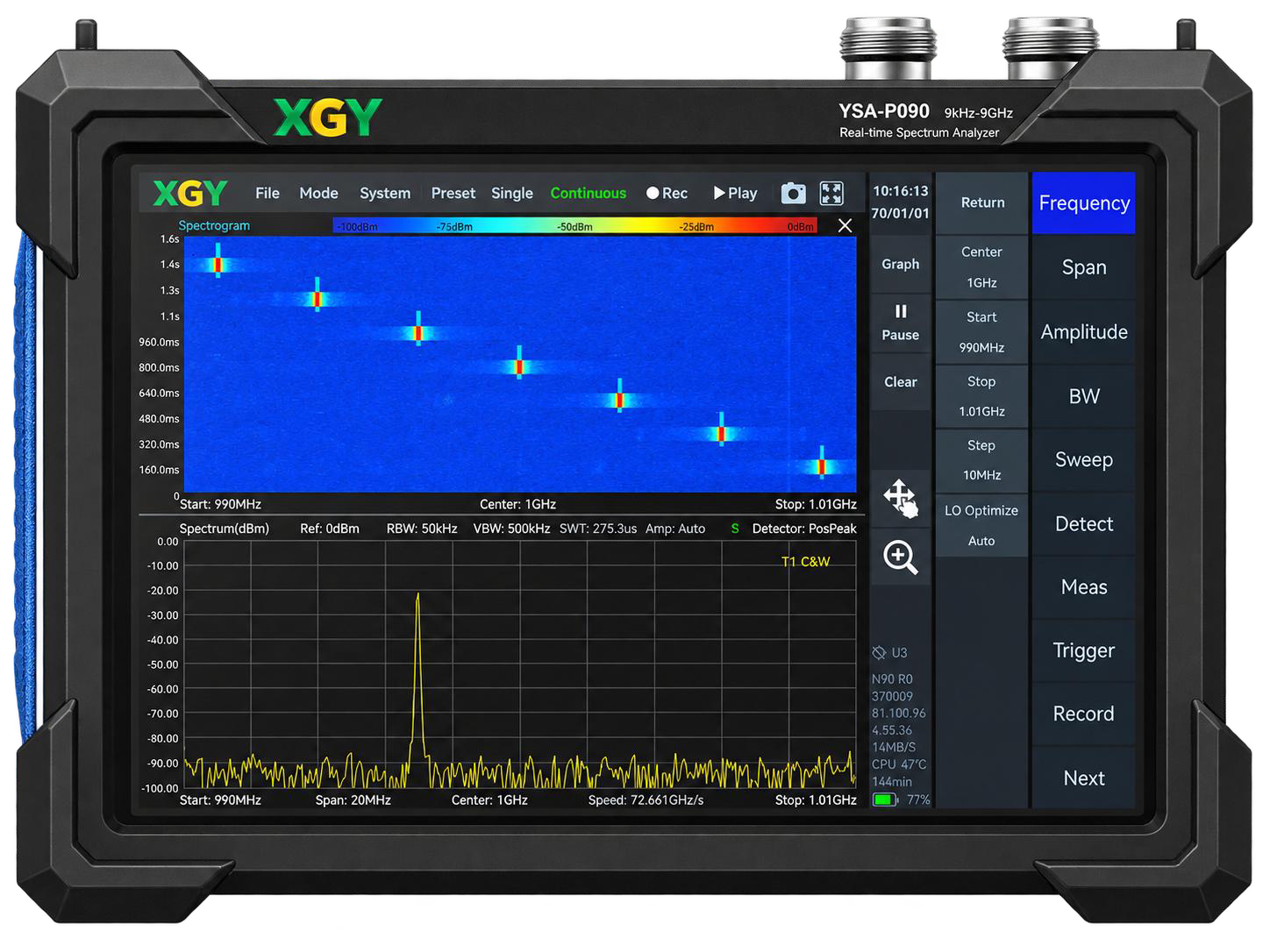
YSA-P090
Handheld Real-Time Spectrum Analyzer
Frequency range: 9 kHz to 9 GHz
View detailsSpectrum Analyzers
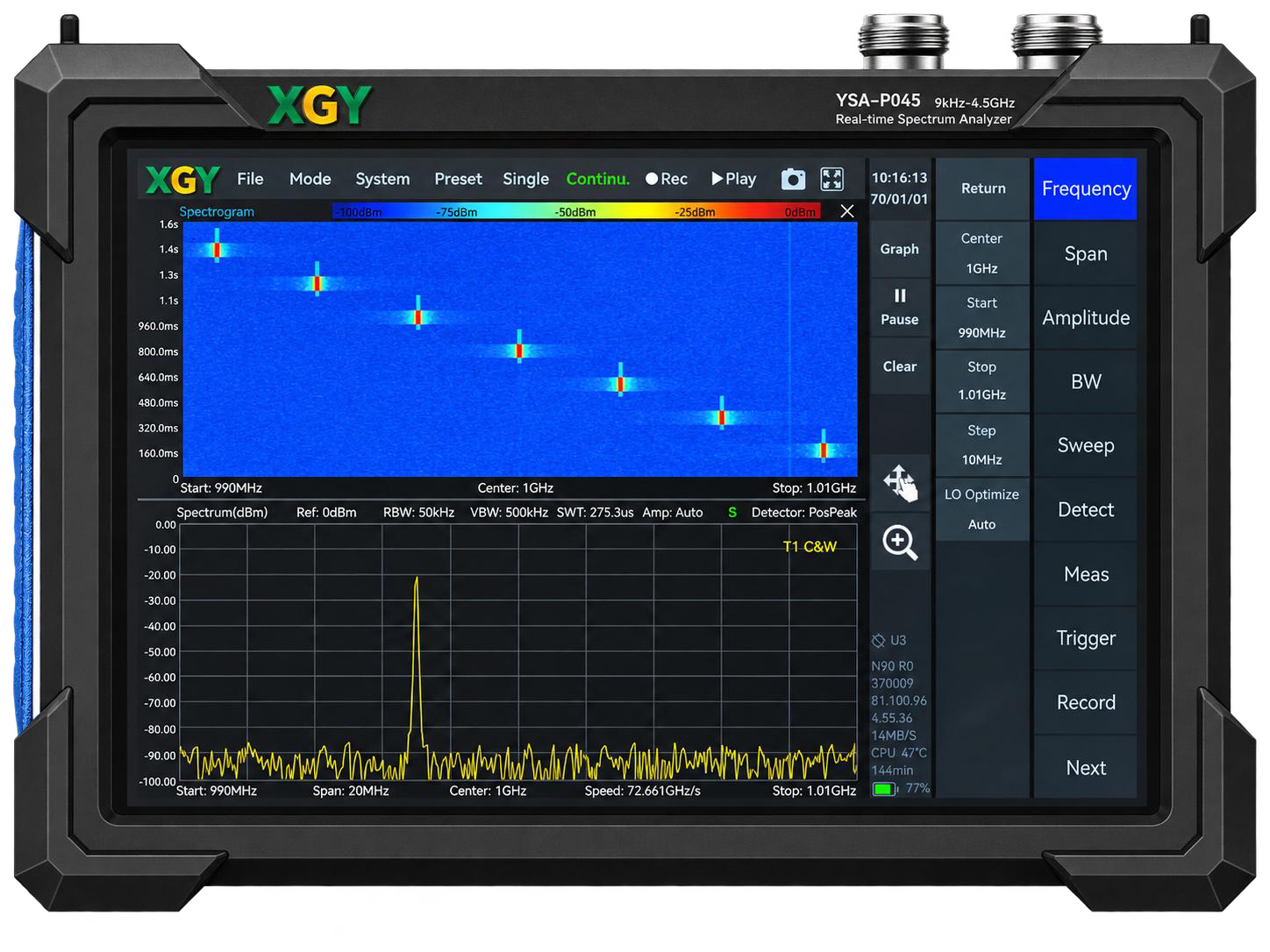
YSA-P045
Handheld Real-Time Spectrum Analyzer
Frequency range: 9 kHz to 4.5 GHz
View details