
Tunable Laser Sources
XTL-1600 Tunable Laser Source
1500 to 1600 nm Mode-Hopping-Free Laser Sweeps
XTL-1600 provides continuously tunable, mode-hopping-free output across the standard 1500–1600 nm range. Fine wavelength setting and synchronous trigger output support optical-component tests, OFDR, spectroscopy and calibration.
Get a Quote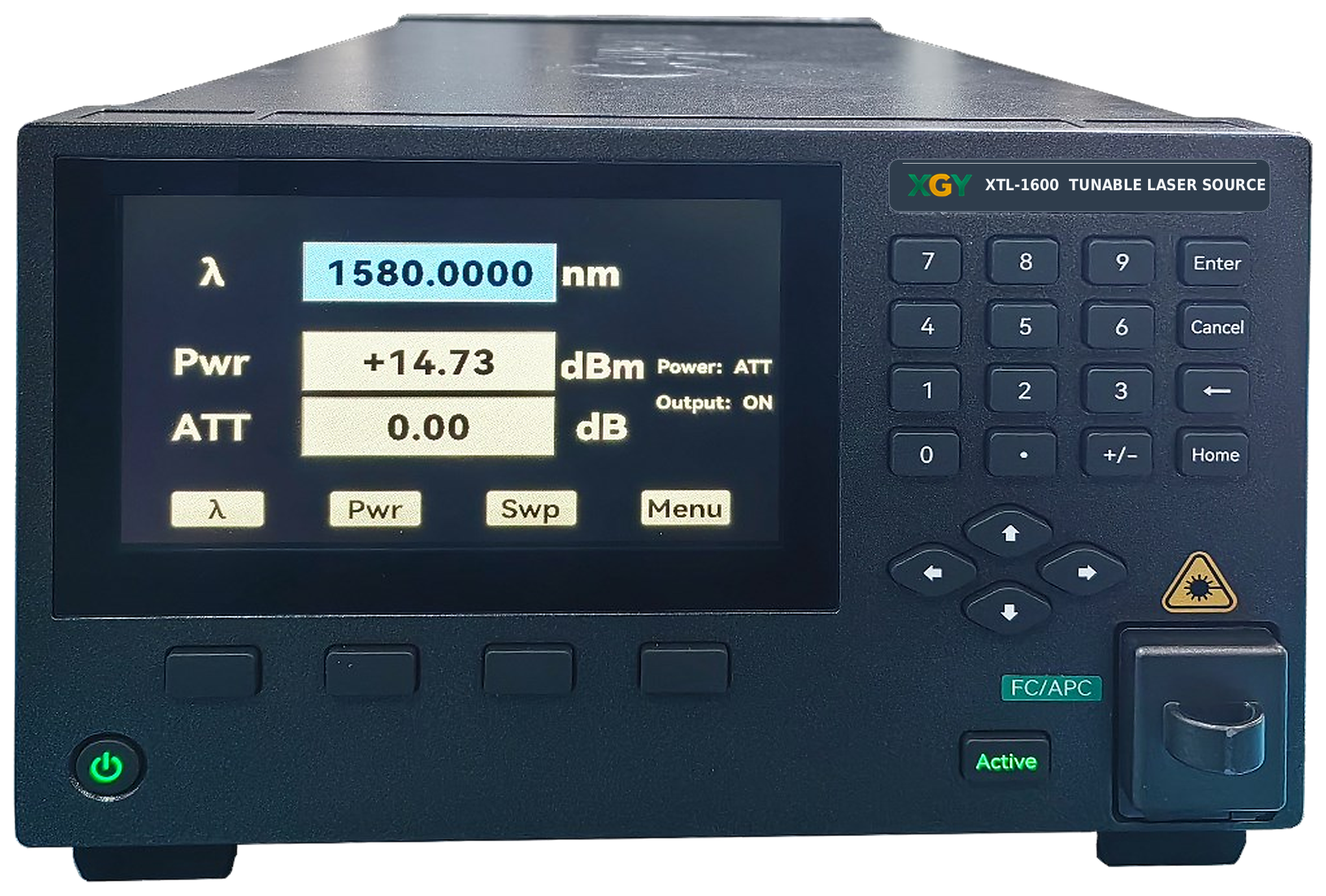
- Wavelength tuning range
- 1500 to 1600 nm
- Wavelength setting resolution
- 0.1 pm
- Absolute wavelength accuracy [2]
- ±3 pm
- Scanning speed
- 0.1 to 240 nm/s
Overview
XTL-1600 provides continuously tunable, mode-hopping-free output across the standard 1500–1600 nm range. Fine wavelength setting and synchronous trigger output support optical-component tests, OFDR, spectroscopy and calibration.
Additional product details
The XTL-1600 provides a continuously tunable optical source with wavelength tuning range 1500 nm to 1600 nm for photonics, fiber-optic, and optoelectronic measurement.
A 0.1 pm wavelength setting resolution, ±3 pm absolute wavelength accuracy, and 0.1 to 240 nm/s scan speed support precise swept-wavelength testing.
Precision Swept-Wavelength Source for Optical Test
The XTL-1600 combines a high-accuracy motion system with a precision optical resonator to deliver high-power, narrow-linewidth, mode-hopping-free continuous wavelength sweeping across the standard 1500-1600 nm range.
High wavelength and power repeatability, together with synchronous trigger-level output during wavelength scanning, supports optical-component characterization, OFDR, spectroscopy, and calibration workflows.
Measurement Planning
The XTL-1600 ±3 pm absolute accuracy is specified at 25±1°C for demanding wavelength-sensitive measurements.
The XTL-1600 has a wide continuous scanning-speed range, with a scan speed of 0.1 to 240 nm/s supporting both fine and fast sweeps.
The XTL-1600 peak output is ≥13 dBm.
The XTL-1600 ±0.01 dB power stability in optical output performance provides stable source power for consistent measurements during scanning.
The XTL-1600 has <100 kHz typical linewidth for high-resolution interferometric and spectral work.
Key Capabilities & Applications
Fine wavelength control
0.1 pm setting resolution and ≥10 GHz fine tuning support precise setup. Absolute wavelength accuracy is ±3 pm at 25 ±1 °C and ±5 pm under working-temperature conditions.
Continuous optical sweeps
Scanning speed is 0.1–240 nm/s, with synchronous trigger-level output for swept-wavelength test systems.
Conditioned optical stability
±0.01 dB power stability requires Auto power mode, output above 0 dBm, one-hour duration and ±0.5 °C temperature change. Specifications require ≥1 hour warm-up outside water-absorption bands.
All capabilities and operating conditions
1500-1600 nm coverage
Standard tuning range for telecom and photonic component measurements.
0.1 pm setting resolution
Fine wavelength control supports precise step tuning and repeatable sweeps.
Mode-hopping-free sweep
Full-range mode-hopping-free operation supports continuous swept-wavelength tests, and the source uses a precision optical resonator.
Common applications
- Characterization of optical components and modules
- Quantum photonics
- Spectroscopy
- Fiber optic transmission testing
- Optical frequency domain reflection analysis
- Measurement calibration and metrology
Applications and test requirements
Characterization of optical components and modules
Measure wavelength-related characteristics of silicon photonic chips, filters, wavelength-selective switches, and other optoelectronic devices.
Quantum photonics
Provide a stable tunable optical source for research and measurement in quantum-photonics systems.
Spectroscopy
Use narrow-linewidth tunable output for wavelength-dependent spectroscopic measurements.
Fiber optic transmission testing
Support tunable-source requirements for fiber-optic transmission and component verification.
Optical frequency domain reflection analysis
Mode-hopping-free wavelength sweeping and narrow linewidth support high spatial resolution and positioning accuracy in OFDR.
Measurement calibration and metrology
Laboratories, enterprise research and development centers, and measurement and testing institutions.
Technical Specifications
| Parameter | Specification |
|---|---|
| Wavelength control and scanning | |
| Wavelength tuning range | 1500 to 1600 nm |
| Wavelength setting resolution | 0.1 pm |
| Absolute wavelength accuracy [2] | ±3 pm |
| Scanning speed | 0.1 to 240 nm/s |
| Fine tuning range | ≥ 10 GHz |
| Optical output performance | |
| Power stability [1][3] | ±0.01 dBOptical output performance |
| Linewidth (Typical) | |
| Intrinsic linewidth (kHz) | <10 |
| Connection and general | |
| Optical port type | FC/APC |
View all 22 specifications
| Parameter | Specification |
|---|---|
| Wavelength control and scanning | |
| Wavelength stability [1] | ±2 pm (typical ±1 pm) |
| Absolute accuracy under working temperature | ±5 pm |
| Repeatability | ±2 pm (typical ±1 pm) |
| Optical output performance | |
| Power repeatability [3] | ±0.01 dBOptical output performance |
| Relative intensity noise (typical) [4] | -145 dB/Hz (1 MHz to 3 GHz)Optical output performance |
| Linewidth (Typical) | |
| Self time delay [5] (kHz) | <100 |
| Spectral characteristics | |
| Side-mode suppression ratio | ≥ 45 dBTypical |
| Spontaneous radiation ratio [6] | ≥ 65 dB |
| Connection and general | |
| Dimensions (W × H × D) | 213 × 133 × 451 mm |
| Weight | 7 kg |
| Power supply | 100-240 VAC, 50/60 Hz ±5% |
| Rated power consumption | 30 VA |
| Working conditions | 15 to 35 °C; relative humidity ≤ 80% |
| Peak output power | ≥13 dBm |
- Performance values apply only under the listed conditions and over the stated wavelength range.
- * All specifications are based on at least 1 hour warmup. The specifications are applicable to wavelengths outside the range of water absorption wavelengths.
- [1] 1 hour duration, with ±0.5°C temperature change
- [2] Environmental temperature:25±1°C
- [3] Under “Auto” power mode, and output power is greater than 0dBm
- [4] Maximum output power
- [5] The length of the reference time delay fiber should be less than 2km
- [6] The optical spectrum analyzer should be set to 0.02nm resolution and 6nm span.
- [7] From start wavelength to 1650nm.
Specifications are subject to change without notice.
Models, Configuration & Compatibility
XTL-1600
Control interfaces and software
Synchronous trigger-level output during wavelength scanning supports swept-wavelength test systems. The optical port is FC/APC.
Synchronous trigger output · FC/APC
Order codes and configuration are confirmed in the quotation.
Technical Resources
Selection guidance
Format: Tunable laser source
Coverage: Wavelength tuning range 1500 to 1600 nm
Best for: Optical component characterization and OFDR.
View the Tunable Laser Sources categorySend the operating envelope, configuration and acceptance evidence you need; the quotation confirms model, options and delivery documentation.