
Signal Generators
YSG-H060 Handheld Vector Signal Generator
6 GHz Handheld Vector Signal Generator
YSG-H060 generates RF signals from 9 kHz to 6 GHz, with 100 MHz buffered IQ playback or 50 MHz continuous IQ streaming and an integrated touchscreen.
Get a Quote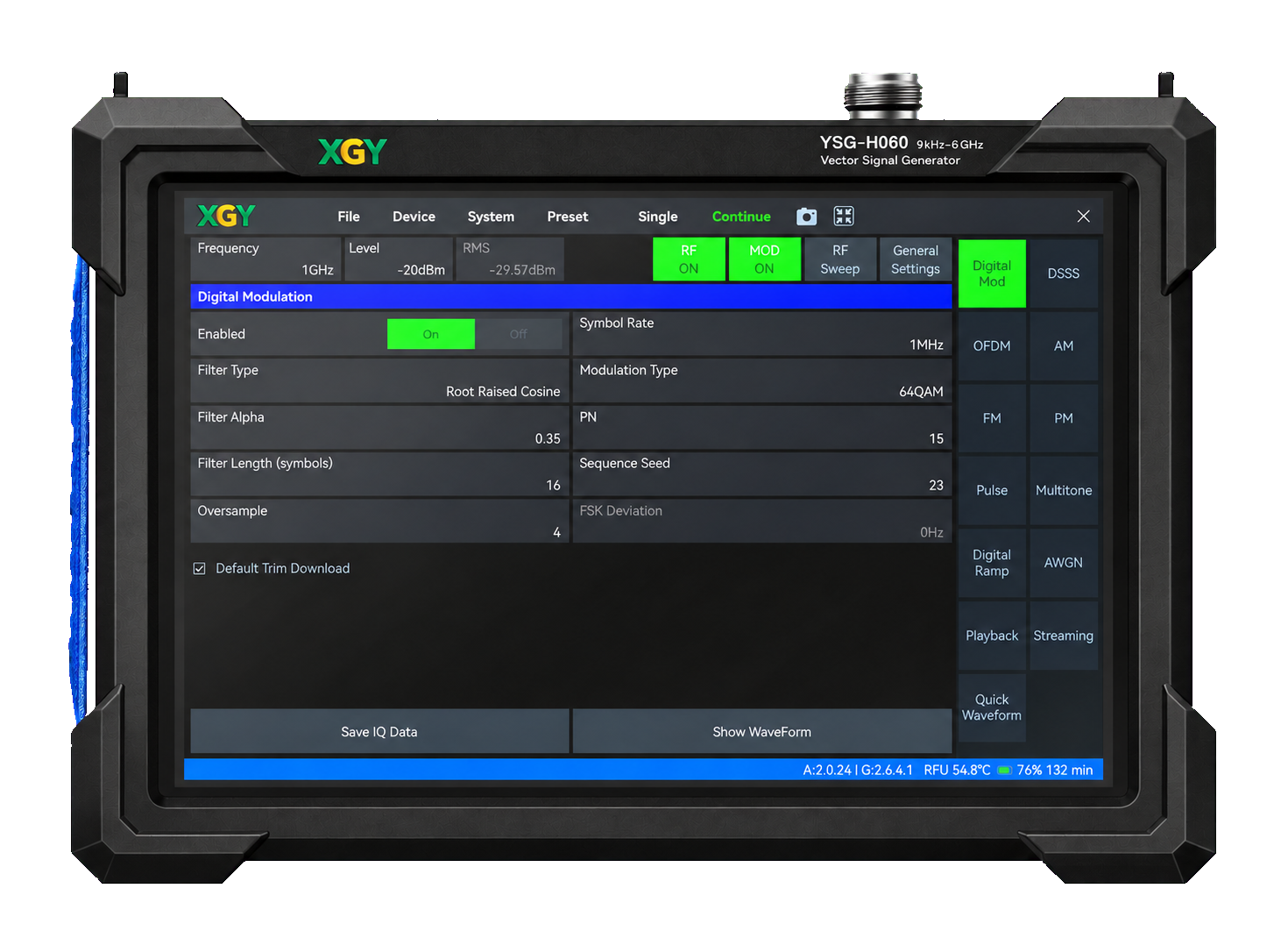
- Frequency range
- 9 kHz to 6 GHz
- Frequency resolution
- 1 Hz for output frequency < 500 MHz
- Frequency accuracy
- ≤ 0.25 ppm, supports GNSS correction
- Modulation bandwidth
- 100 MHz RAM playback, 50 MHz continuous streaming
Overview
YSG-H060 combines RF signal generation from 9 kHz to 6 GHz with a 16-bit DAC, buffered waveform playback and continuous host IQ streaming. Standard functions include tone generation, frequency and power sweeps, AM, FM, PM and pulse modulation.
SGStudio controls sweeps and waveform playback, with LAN remote control for integrated setups. The 1.4 kg handheld instrument has a 10.1-inch multi-touch display and supports USB PD power-bank operation.
Product & Measurement Gallery
Clear and User-Friendly Interface
IQ Streaming and Playback
Digital Modulation Signal Output
Medium Power Output (opt.YSG-H060-10)
RF Frequency and Power Sweep Control
Basic AM/FM/PM Signal Output
Basic Pulse Signal Output
Multitone Signal Output
Digital Ramp Sweep
Additional product details
The YSG-H060 features a 10.1-inch multi-touch display and an intuitive interface. At a weight of only 1.4 kg, it is ideal for both laboratory and field applications.
The YSG-H060 delivers top-tier RF performance, including wide output power range, low harmonics, low phase noise, and excellent spur suppression. The YSG-H060 delivers excellent performance and portability while maintaining outstanding cost-effectiveness.
The YSG-H060 comes standard with a wide range of essential test signal generation functions, including single tone, multi-tone, frequency sweep, power sweep, digital ramp sweep, pulse modulation, and Gaussian white noise. Additionally, the series supports analog modulation schemes such as AM, FM, and PM, alongside robust IQ playback and real-time streaming capabilities.
On the YSG-H060, 1 GHz phase noise is -124 dBc/Hz@10 kHz; maximum output power is 7 dBm to 14 dBm, 25 dBm (opt.); minimum output power is ≤-100 dBm across the full frequency range; harmonics are ≤-50 dBc (0 dBm output, typical). The YSG-H060 supports fine reference frequency adjustment, and its built-in GNSS serves timing, positioning, and frequency calibration. The YSG-H060 RF output is marked RF OUT 50Ω and 10 VDC MAX.
SGStudio software
SGStudio features a user-friendly interface designed for ease operation. The GUI is logically organized into five key functional areas: the Menu bar, RF parameter settings, mode selection, mode parameter settings, and status information.
SGStudio provides comprehensive RF control, supporting single tone, frequency sweep, and power sweep modes. It simplifies complex characterization tasks, enabling users to perform automated frequency response and compression point testing directly through the GUI-eliminating the need for custom programming.
SGStudio supports continuous real-time waveform streaming from the host for playback, as well as waveform buffering in the device’s internal memory for subsequent playback. Buffered playback supports wider signal bandwidth and requires no host intervention during playback, thereby fully freeing host processing resources. In buffered playback mode, the maximum waveform length is limited by the capacity of the device’s internal memory.
Signal output functions
Engineered for versatility, the YSG-H060 supports an extensive library of modulation schemes, ranging from fundamental ASK, FSK, and PSK to high-order 1024QAM. The architecture is specifically optimized for modern wireless standards, with support for DSSS and OFDM to facilitate advanced signal generation for both field testing and R&D verification.
The YSG-H060 supports analog modulation formats, including AM, FM, and PM. Each of the three modulation types supports a variety of modulation signal formats, with configurable parameters including modulation rate, modulation index, frequency deviation, phase deviation, and initial phase, accommodating routine analog modulation signal generation and RF testing requirements.
The YSG-H060 supports basic pulse signal output with configurable pulse repetition period, duty cycle, and pulse width.
The YSG-H060 supports the generation of multi-tone RF signals composed of multiple discrete tones. Users can configure the number of tones, tone spacing, and phase mode. In-band notches can also be configured relative to the RF center frequency, making this function suitable for dynamic range, intermodulation distortion, and frequency-response flatness testing.
The YSG-H060 supports linear digital ramp frequency sweeps with configurable sweep span, sweep time, and sweep period. This function is suitable for radar signal simulation, wideband excitation, and frequency-response testing.
Key Capabilities & Applications
Play or stream IQ waveforms
Buffered playback supports 100 MHz modulation bandwidth using 128 MB of built-in memory. Continuous host streaming supports 50 MHz bandwidth; buffered playback needs no host intervention while running.
Generate varied test signals
Standard functions include single tone, multitone, sweeps, Gaussian white noise, analog modulation and pulse modulation. Basic digital formats include ASK, FSK, PSK, APSK and QAM.
Configure reference and output
Internal or external reference operation and GNSS correction are supported. Optional YSG-H060-10 medium-power hardware covers 10 MHz to 6 GHz with at least 25 dBm typical maximum output.
Common applications
- Field receiver checks with a portable vector source
- Automated frequency response and compression point testing
- Dynamic range and intermodulation distortion testing with multitone signals
- Radar signal simulation and wideband excitation with digital ramp sweeps
- Digital modulation signal generation for field testing and R&D verification
Technical Specifications
| Parameter | Specification |
|---|---|
| Frequency | |
| Frequency range | 9 kHz to 6 GHz |
| Frequency resolution | 1 Hz for output frequency < 500 MHz; 0.1 Hz for 500 MHz ≤ output frequency ≤ 6 GHz |
| LO switching time | ≤ 100 µs pre-programmed; ≤ 50 ms software controlled |
| Reference clock | Internal or external, manual correction or GNSS calibration is available |
| Frequency accuracy | ≤ 0.25 ppm, supports GNSS correction |
| Signal processing | |
| Modulation bandwidth | 100 MHz RAM playback, 50 MHz continuous streaming |
| Spectrum purity | |
| EVM | 1 GHz: ≤ 0.3% 1 MSPS QAM 16, Alpha = 0.35; ≤ 0.5% 10 MSPS QAM 64, Alpha = 0.35; 6 GHz: ≤ 0.5% 1 MSPS QAM 16, Alpha = 0.35; ≤ 1.0% 10 MSPS QAM 64, Alpha = 0.35Typical |
| Harmonics CW, 0 dBm | 100 MHz: ≤-45 dBc; 1 GHz: ≤-50 dBc; 3 GHz: ≤-60 dBc; 6 GHz: ≤-75 dBc |
View all 15 specifications
| Parameter | Specification |
|---|---|
| Frequency | |
| Aging and temperature stability | ≤ 1 ppm/year, ≤ 0.25 ppm |
| Built-in GNSS 1PPS accuracy | ±100 ns |
| SSB phase noise (dBc/Hz) | |
| SSB phase noise (1 kHz) | 1 GHz: -115; 3 GHz: -105; 6 GHz: -98 |
| SSB phase noise (10 kHz) | 1 GHz: -124; 3 GHz: -114; 6 GHz: -108 |
| SSB phase noise (100 kHz) | 1 GHz: -125; 3 GHz: -116; 6 GHz: -110 |
| SSB phase noise (1 MHz) | 1 GHz: -138; 3 GHz: -128; 6 GHz: -122 |
| Spectrum purity | |
| Non-harmonic spurious | 9 kHz to 500 MHz: worst-case spurious ≤-50 dBc; 500 MHz to 6 GHz, 1 MHz step size, 20 MHz observation bandwidth: spurious level ≤-80 dBc at approximately 98% of frequency points, worst-case spurious ≤-55 dBc |
Detailed performance and interface tables (6)
Amplitude (2 rows)
| Parameter | 9 kHz | 100 MHz | 1 GHz | 3 GHz | 6 GHz |
|---|---|---|---|---|---|
| Maximum output power (dBm) | ≥ 0 | ≥ 7 | ≥ 14 | ≥ 14 | ≥ 7 |
| Minimum output power (dBm) | ≤-100 | ≤-100 | ≤-100 | ≤-100 | ≤-100 |
Amplitude accuracy and step size (2 rows)
| Parameter | Value |
|---|---|
| Power accuracy (Guaranteed/Typical) | Output power ≥-45 dBm: ±1.2 dB / 0.7 dB; output power -80 to -45 dBm: ±1.5 dB / 1.2 dB; output power -100 to -80 dBm: ±2.0 dB / 1.8 dB |
| Power setting step size | 0.1 dB |
Signal processing (5 rows)
| Parameter | Value |
|---|---|
| Standard function | Single tone, multitone, frequency sweep, power sweep, AM, FM, PM, pulse modulation, digital ramp sweep, Gaussian white noise, IQ playback, real-time IQ streaming |
| Modulation bandwidth | 100 MHz RAM playback, 50 MHz continuous streaming |
| Built-in memory depth | 128 MB (32 M samples) |
| IQ sampling rate | 195.3125 kHz to 125 MHz, step size ≤ 10 Hz |
| Basic modulation signal generation | APSK: 16APSK; ASK: 2ASK, 4ASK, 8ASK; FSK: 2FSK, 4FSK, 8FSK, 16FSK; QAM: 16QAM, 64QAM, 256QAM, 1024QAM; PSK: BPSK, QPSK, 8PSK, 16PSK, DBPSK, DQPSK, D8PSK, Pi/4 DQPSK |
Input and output (10 rows)
| Parameter | Value |
|---|---|
| Power | USB PD (65 W), supports power bank operation |
| RF output | N (F), output impedance 50 Ω |
| USB port | USB3.0 Type-C * 1, USB2.0 Type-C * 1, USB2.0 Type-A * 1 |
| Ethernet port | RJ45, 1000 Mbps, supports LAN remote control |
| Video and audio interface | Micro HDMI * 1 (supports extended display), 3.5 mm headphone port * 1 |
| External reference clock input | MMCX (F), 10 MHz, amplitude ≥ 1.5 Vpp, impedance 200 Ω |
| Reference clock output | MMCX (F), 100 MHz, 3.3 V CMOS, programmable On/Off |
| External trigger input | MMCX (F), 3.3 V CMOS, high impedance |
| Trigger output | MMCX (F), 3.3 V CMOS |
| GNSS antenna input | MMCX (F) |
General (13 rows)
| Parameter | Value |
|---|---|
| Display | IPS LCD 1280 × 800, 10.1-inch multi-touch screen |
| RAM / EMMC storage | 4 GB/32 GB |
| Compute module | Raspberry Pi Compute Module 5 |
| Processor | Broadcom BCM2712, Quad-core 64-bit Arm Cortex-A76, 2.4 GHz |
| Power consumption | 35 W (typ.) |
| Battery life | 2.5 hours (typ.) |
| Size (D × W × H) | 260 × 185 × 46 mm |
| Weight | 1.4 kg |
| Built-in GNSS 1PPS accuracy | ±100 ns, the built-in GNSS requires an external antenna |
| Operating temperature (ambient) | 0 to 50 °C |
| Storage temperature (ambient) | -20 to 70 °C |
| Operating relative humidity | Ambient Temp.: 0 to 40 °C: 5 to 75%; ambient Temp.: >40 °C: 5 to 45% |
| Packaging accessories | Main unit * 1, power adapter * 1, power cable * 1 |
Medium Power Output(opt.YSG-H060-10) (5 rows)
| Parameter | Value |
|---|---|
| Frequency range | 10 MHz to 6 GHz |
| Maximum output power | ≥ 25 dBm (typ.) |
| Minimum output power | ≤-80 dBm (typ.) |
| Power accuracy (Guaranteed / typical) | Output power ≥-20 dBm: ±1.2 dB / 0.7 dB; output power -60 to -20 dBm: ±1.5 dB / 0.7 dB; output power -80 to -60 dBm: ±2.5 dB / 1.2 dB |
| Harmonics (CW, 0 dBm) | 100 MHz: ≤-55 dBc; 1 GHz: ≤-50 dBc; 3 GHz: ≤-42 dBc; 6 GHz: ≤-46 dBc |
- (1) 10 min warm-up after power-on
- (2) Ambient temperature: 25 °C (instrument temperature: 50 °C)
- (3) With adequate cooling ensuring both ambient and core temperatures remain within the rated range
Performance notes
Some YSG-H060 spectrum and waveform illustrations are shown using measurement screens from spectrum analyzer software.
Specifications are subject to change without notice.
Models, Configuration & Compatibility
YSG-H060
Options
| Code | Description | Standard | Requires / excludes |
|---|---|---|---|
| YSG-H060-05 | Internal high precision GNSS built-in hardware | Not stated | — |
| YSG-H060-10 | Medium power output built-in hardware | Not stated | — |
Standard delivery contents
- Main unit (×1)
- Power adapter (×1)
- Power cable (×1)
Model selection details
The YSG-H060 offers an optional medium-power RF output port, delivering up to 25 dBm of output power over the 10 MHz to 6 GHz frequency range. This option is ideal for applications requiring higher excitation levels, such as device testing and system integration.
Control interfaces and software
SGStudio supports RF frequency and power sweeps, IQ streaming and buffered waveform playback. Buffered playback uses internal memory without host intervention during playback; continuous real-time streaming uses the host. The Ethernet interface supports LAN remote control.
SGStudio · LAN remote control · IQ streaming and playback
Technical Resources
Selection guidance
Format: Handheld vector source
Coverage: 9 kHz to 6 GHz; 16-bit DAC; 100 MHz playback and 50 MHz real-time IQ streaming
Best for: Field receiver checks and portable vector signal work where a benchtop generator cannot travel to the device.
Compare products in the Signal Generators categorySend the operating envelope, configuration and acceptance evidence you need; the quotation confirms model, options and delivery documentation.
Related Products & FAQ
Signal Generators
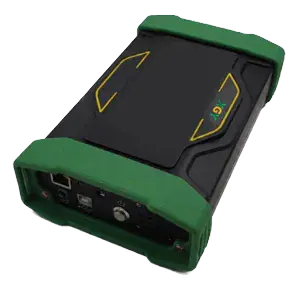
YSG-P400 Series
Portable RF Signal Generator
Frequency range: 200 MHz to 40 GHz
View detailsSignal Generators
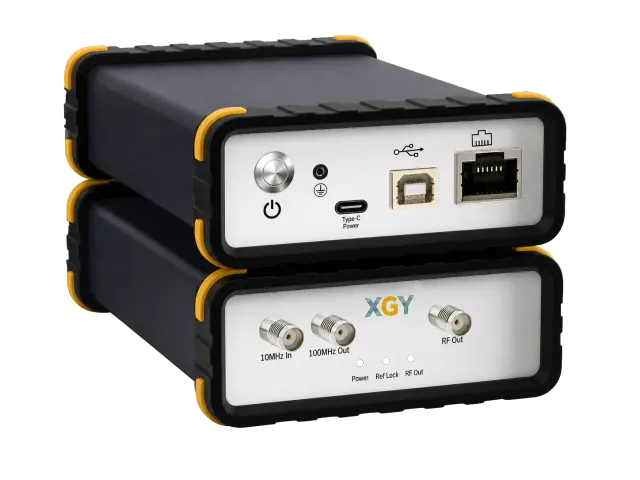
YSG-140
Low Phase Noise Frequency Source
Frequency range: 1 to 52 GHz (Factory-set RF output)
View detailsSignal Generators
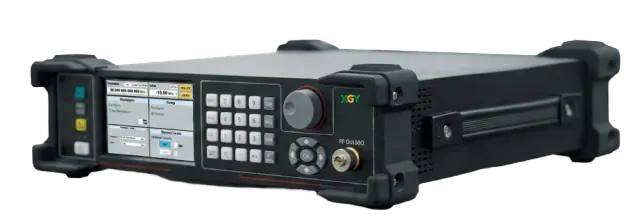
YSG-400B Series
Signal Generator
Frequency range: 9 kHz to 40 GHz
View details