
Power Supplies
N692 High Power Programmable DC Electronic Load
2 kW to 60 kW Programmable DC Electronic Load by Model
N692 provides high-power electronic-load testing for R&D and ATE systems. Standalone input power spans 2 to 60 kW, with voltage classes from 150 V to 2400 V and current ratings up to 2500 A by model.
Get a Quote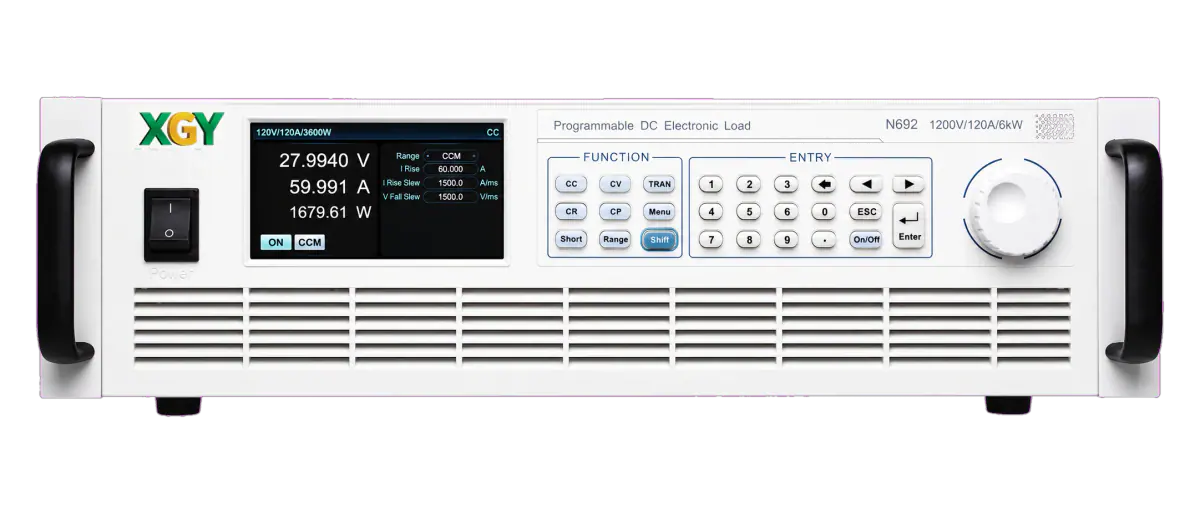
- Standalone input power
- 2 to 60 kW
- Current range
- Up to 2500 A
- Dynamic mode
- Up to 30 kHz
- Voltage measurement accuracy
- 0.015% + 0.015% F.S.
Overview
N692 provides high-power electronic-load testing for R&D and ATE systems. Standalone input power spans 2 to 60 kW, with voltage classes from 150 V to 2400 V and current ratings up to 2500 A by model.
Additional product details
N692 uses a modular 3U/19-inch architecture for high-density power loading and scalable high-current or high-voltage test systems. The N692 current range extends up to 2500 A by model. Programmable dynamic load mode and arbitrary waveform loading are supported on the N692.
Key Capabilities & Applications
Power and voltage selection
Choose a load against its simultaneous voltage, current and power limits. The 19-inch platform provides up to 6 kW in 3U on applicable models.
Dynamic and protection tests
Dynamic mode reaches up to 30 kHz, with 500 kHz sampling for dynamic sweeps. OCP/OPP, short-circuit and battery workflows are supported; DCIR / ESR functions are optional.
Parallel and remote operation
Models with the same voltage specification support parallel expansion. LAN, RS232, CAN, USB HOST and digital/analog I/O are listed; GPIB is optional.
All capabilities and operating conditions
High power density
A 3U chassis can provide up to 6 kW, reducing size and weight compared with traditional loads.
Wide voltage coverage
Voltage specifications include 150 V, 600 V, 1200 V, 1600 V, and 2400 V.
Parallel expansion
Master/master and master/slave parallel operation expand current and power capacity.
Battery and protection tests
Charge/discharge, OCP/OPP, short-circuit simulation, optional DCIR, and optional ESR-related workflows are supported.
Common applications
- New energy
- High-power supplies
- Power electronics
- Advanced test systems
Applications and test requirements
New energy
Fuel-cell stacks, lithium battery packs, supercapacitors, and photovoltaic modules.
High-power supplies
Industrial, server, communication, generator, energy-storage, and DC charging systems.
Power electronics
UPS, DC-DC converters, on-board chargers, relays, contactors, and automotive high-voltage accessories.
Advanced test systems
Electric vehicles, semiconductors, aerospace, and high-power automated testing.
Technical Specifications
| Parameter | Specification |
|---|---|
| Core ratings and functions | |
| Standalone input power | 2 to 60 kW |
| Voltage range | 0 to 150 V / 600 V / 1200 V / 1600 V / 2400 V by model |
| Current range | Up to 2500 A |
| Dynamic mode | Up to 30 kHz; 500 kHz sampling for dynamic frequency sweep |
| Voltage measurement accuracy | 0.015% + 0.015% F.S. |
| Current measurement accuracy | 0.04% + 0.04% F.S. |
| Interfaces | LAN, RS232, CAN, USB host, digital I/O, analog I/O; optional GPIB |
| Optional measurement functions | DCIR / ESROptional functions |
View all 9 specifications
| Parameter | Specification |
|---|---|
| Rack power density | Up to 6 kW in 3U19-inch platform; model dependent |
Performance notes
Where the limit actually falls on a high-power load
On a 60 kW N692 load the binding constraint is rarely the power figure: steady-state absorption, the 150 V to 2400 V class ceiling and the current ceiling of up to 2500 A all apply at the same operating point, and the lowest of the three decides what is achievable. Where the test is a converter’s transient response rather than its steady draw, the 30 kHz dynamic mode and the 500 kHz sampling of the dynamic frequency sweep are what has to be sized, and at currents approaching 2500 A the inductance of the load cabling limits the achievable current slew regardless of the load’s own bandwidth. Because a 3U chassis carries up to 6 kW, a requirement far above that figure is a rack-height, busbar and floor-loading question before it is an instrument question.
Specifications are subject to change without notice.
Models, Configuration & Compatibility
N692
Model comparison (1)
| Voltage class | Power range | Current range | Rack size |
|---|---|---|---|
| 150 V | 2 to 60 kW | 200 to 2500 A | 3U to 32U |
| 600 V | 2 to 60 kW | 140 to 2500 A | 3U to 32U |
| 1200 V | 2 to 60 kW | 40 to 2400 A | 3U to 32U |
| 1600 V | 3 to 50 kW | 40 to 600 A | 3U to 32U |
| 2400 V | 3 to 50 kW | 40 to 600 A | 3U to 32U |
Representative configuration ranges. Maximum voltage, current and power do not describe one simultaneous operating point.
Model selection details
Ordering and integration notes
Options on the N692 are ordered rather than enabled: DCIR, ESR-related workflows and GPIB are all listed as optional, while LAN, RS232, CAN, USB host, digital I/O and analog I/O are standard - and the analog and digital I/O are the pair that matter when the load has to take a start signal from a PLC inside an automated test cabinet. Plan the room’s air handling and exhaust path against the full absorbed power, and confirm for the chosen model whether that energy is returned to the grid or dissipated locally. The N692 range begins at 2 kW and 150 V, so a DUT comfortably below that is better served by a benchtop load than by a rack chassis and its facility connection.
Control interfaces and software
LAN, RS232, CAN, USB HOST and digital/analog I/O are listed. GPIB is optional. Parallel operation uses a master load and slave current sharing.
LAN · RS232 · CAN · USB HOST · Digital/analog I/O · Optional GPIB
Technical Resources
Selection guidance
Format: High-power DC electronic load
Coverage: 150 V to 2400 V voltage classes; 2 to 60 kW input power; up to 2500 A current
Best for: High-power battery, fuel-cell, power-supply, and production ATE loading with modular expansion.
Compare products in the Power Supplies categorySend the operating envelope, configuration and acceptance evidence you need; the quotation confirms model, options and delivery documentation.
Related Products & FAQ
Power Supplies
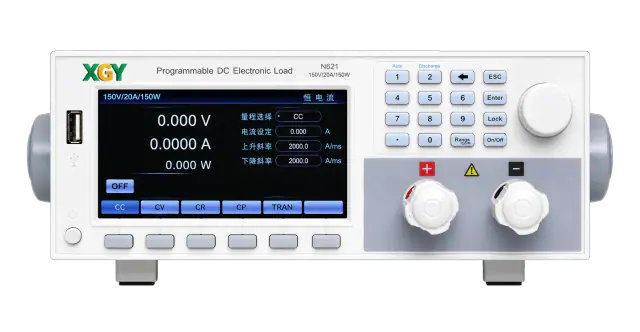
N621
High Performance Benchtop DC Electronic Load
Power range: 150 W / 300 W / 600 W
View detailsPower Supplies
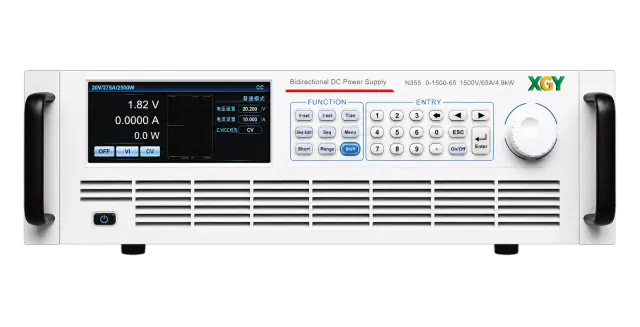
N355
High Power Bidirectional Programmable DC Power Supply
Voltage range: 0 to 2250 V by model
View detailsPower Supplies
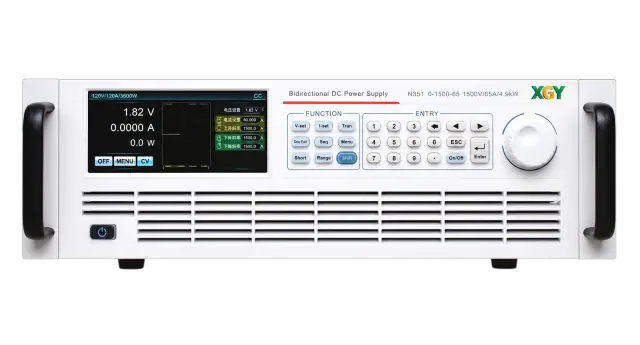
N351
Bidirectional Programmable DC Power Supply
Power range: 2.5 kW / 5 kW / 7.5 kW
View details