
Power Supplies
N355 High Power Bidirectional Programmable DC Power Supply
High-Power Bidirectional DC Source and Regenerative Load
N355 combines source and sink operation for high-power DC validation and production tests. Standalone 3U models provide up to 42 kW; model selection and parallel configuration determine the available voltage, current and system power.
Get a Quote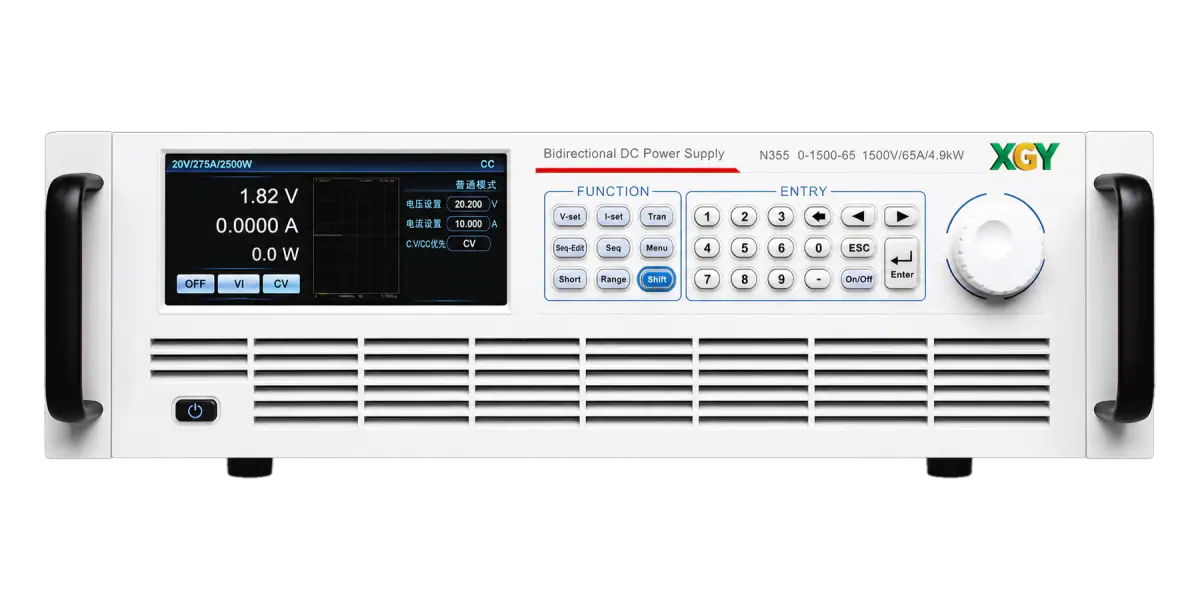
- Voltage range
- 0 to 2250 V by model
- Standalone power density
- Up to 42 kW in 3U
- Current range
- Up to 240 A for 3U models
- Regeneration efficiency
- Up to 93%
- Stated for the series
Overview
N355 combines source and sink operation for high-power DC validation and production tests. Standalone 3U models provide up to 42 kW; model selection and parallel configuration determine the available voltage, current and system power.
Additional product details
On the N355, voltage-control or current-control loop priority can be selected to improve startup behavior and protect low-impedance DUTs.
Facility and control decisions before the order
For the N355, regeneration is a facility question before it is an instrument question: returning absorbed energy to the grid at up to 93% efficiency requires a site that will accept the back-feed, which means confirming the transformer, the protection settings and the agreement covering export. Master/master parallel operation is how the platform passes its up to 42 kW standalone power toward MW-level systems, so a programme expected to grow should be specified as a parallel group at the outset rather than as a single 3U unit. For remote control of the N355, CAN and CANopen suit a bench where the supply shares a bus with the DUT’s own controller, Modbus-RTU over RS485 suits a PLC-driven production cell, and SCPI over LAN suits a scripted lab sequencer.
Key Capabilities & Applications
High-density DC output
Voltage families extend to 2250 V by model. Three-unit-height models provide up to 240 A and up to 42 kW, subject to their selected rating.
Regenerative source/load operation
Absorbed energy can return to the grid with regeneration efficiency up to 93%. Master/master parallel capability supports larger configured systems.
Automation and optional simulation
Standard LAN, RS232, RS485 and CAN support remote control. Photovoltaic and battery simulation software are optional.
All capabilities and operating conditions
High power density
Up to 42 kW output power is provided in a 3U chassis.
Wide voltage coverage
Model families include 360 V, 500 V, 750 V, 1000 V, 1500 V, and 2250 V.
Regenerative operation
The source/load design can return absorbed energy to the grid with efficiency up to 93%.
Common applications
- Laboratory and production-line automatic test systems
- Automotive power
- New energy
- Aerospace electronics, communication equipment, drones, and high-power DUTs
Applications and test requirements
Laboratory and production-line automatic test systems
Automotive power
BOBC, DC-DC, motor drive, charging pile, and power battery charge/discharge tests.
New energy
PV inverter, hydrogen fuel cell, solar-cell matrix, and energy-storage converter tests.
Aerospace electronics, communication equipment, drones, and high-power DUTs
Technical Specifications
| Parameter | Specification |
|---|---|
| Core ratings and functions | |
| Standalone power density | Up to 42 kW in 3U |
| Voltage range | 0 to 2250 V by model |
| Current range | Up to 240 A for 3U models; scalable by parallel/high-power model |
| Voltage accuracy | 0.02% + 0.02% F.S. |
| Current accuracy | 0.1% + 0.1% F.S. |
| Key features | |
| Regeneration efficiency | Up to 93%Stated for the series |
| Core ratings and functions | |
| Standard interfaces | LAN, RS232, RS485, CAN |
| Control protocols | Modbus RTU / SCPI / CANopen |
View all 10 specifications
| Parameter | Specification |
|---|---|
| Core ratings and functions | |
| Display | 6.8-inch LCD screen |
| Key features | |
| Voltage rise and fall time | ≤ 5 msStated for the series |
Performance notes
Sizing a bidirectional supply for charge/discharge profiles
A bidirectional supply sized on steady-state current alone fails at the transitions rather than on the plateau, so size an N355 against the peak of the charge and discharge profile and against the zero crossing where the unit reverses direction under load. The N355’s specified voltage rise and fall time of ≤ 5 ms sets how quickly a commanded step actually arrives at the DUT, so a profile written in shorter steps than that is being averaged rather than executed. Accuracy is quoted with a full-scale term, 0.02% + 0.02% F.S. on voltage and 0.1% + 0.1% F.S. on current, which is the practical reason to choose between the 360 V and 2250 V families on the DUT’s real maximum rather than on headroom.
Specifications are subject to change without notice.
Models, Configuration & Compatibility
N355
Model comparison (1)
| Voltage class | Power range | Current range | Rack size |
|---|---|---|---|
| 360 V | 14 to 420 kW | 80 to 2400 A | 3U to 42U |
| 500 V | 14 to 420 kW | 65 to 1950 A | 3U to 42U |
| 750 V | 14 to 420 kW | 65 to 1950 A | 3U to 42U |
| 1000 V | 22 to 280 kW | 65 to 650 A | 3U to 42U |
| 1500 V | 22 to 420 kW | 60 to 650 A | 3U to 42U |
| 2250 V | 22 to 420 kW | 60 to 650 A | 3U to 42U |
Representative configurations from the selection guide. These are model/configuration ranges, not simultaneous ratings of every 3U unit.
Control interfaces and software
The standard LAN, RS232, RS485 and CAN interfaces support remote integration. Photovoltaic and battery simulation software are options; battery simulation supports standard libraries and imported custom curves.
LAN · RS232 · RS485 · CAN
Order codes and configuration are confirmed in the quotation.
Technical Resources
Selection guidance
Format: High-voltage bidirectional DC
Coverage: 0 to 2250 V voltage by model; up to 42 kW power in 3U; up to 240 A current
Best for: High-voltage battery, traction, and production ATE requiring regenerative source/sink capability and parallel expansion.
Compare products in the Power Supplies categorySend the operating envelope, configuration and acceptance evidence you need; the quotation confirms model, options and delivery documentation.
Related Products & FAQ
Power Supplies
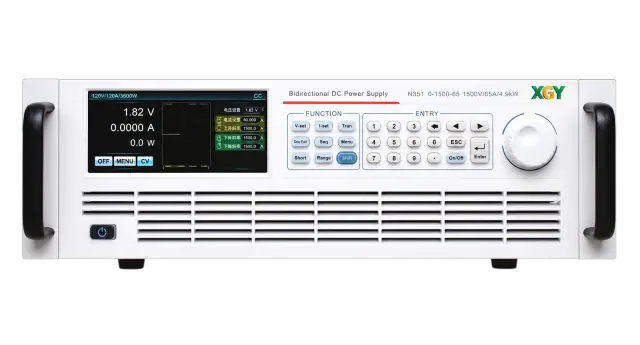
N351
Bidirectional Programmable DC Power Supply
Power range: 2.5 kW / 5 kW / 7.5 kW
View detailsPower Supplies
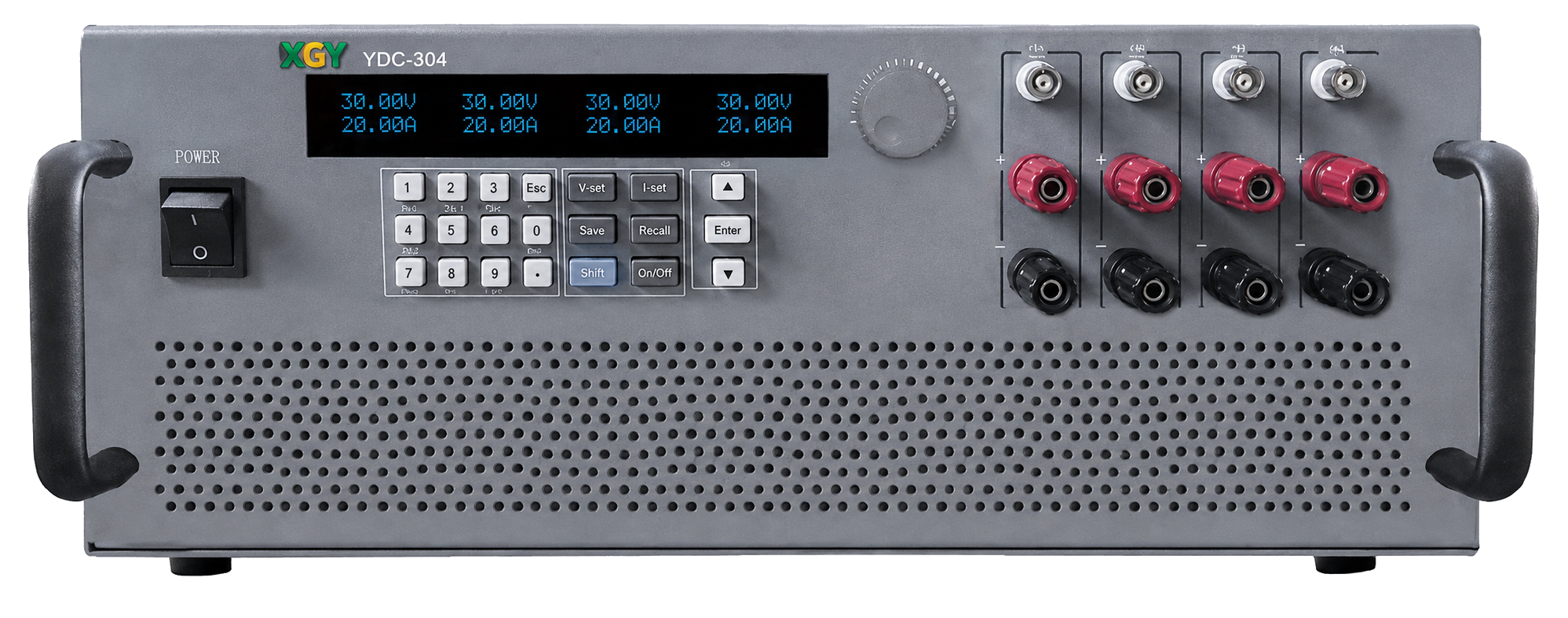
YDC-304 Series
Four-Channel DC Power Supply
Output channels: 4, isolated from one another and independently adjustable
View detailsPower Supplies
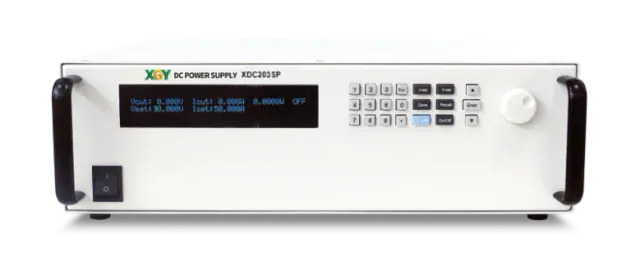
XDC203SP Series
High-Power Linear DC Power Supply
Channels: 1
View details